
Best Noise-Canceling Hearing Aids (2025): How They Work and Top Audiologist Picks
These expert-recommended hearing aids use advanced AI and directional microphones to cut background noise and make conversations clearer.

The best noise-canceling hearing aids, compared
Oticon Real: Best overall
Sony CRE-E10: Best OTC
ReSound Nexia: Best prescription
Phonak Audéo Lumity: Best Bluetooth features
Starkey Genesis AI: Best battery life
Lexie Lumen: Best budget
How noise canceling hearing aids work
How modern hearing aids reduce background noise
How we tested noise canceling hearing aids
Why trust audiologists.org?
We’re reader-supported. When you click on our chosen products, we may receive a commission. Learn more.
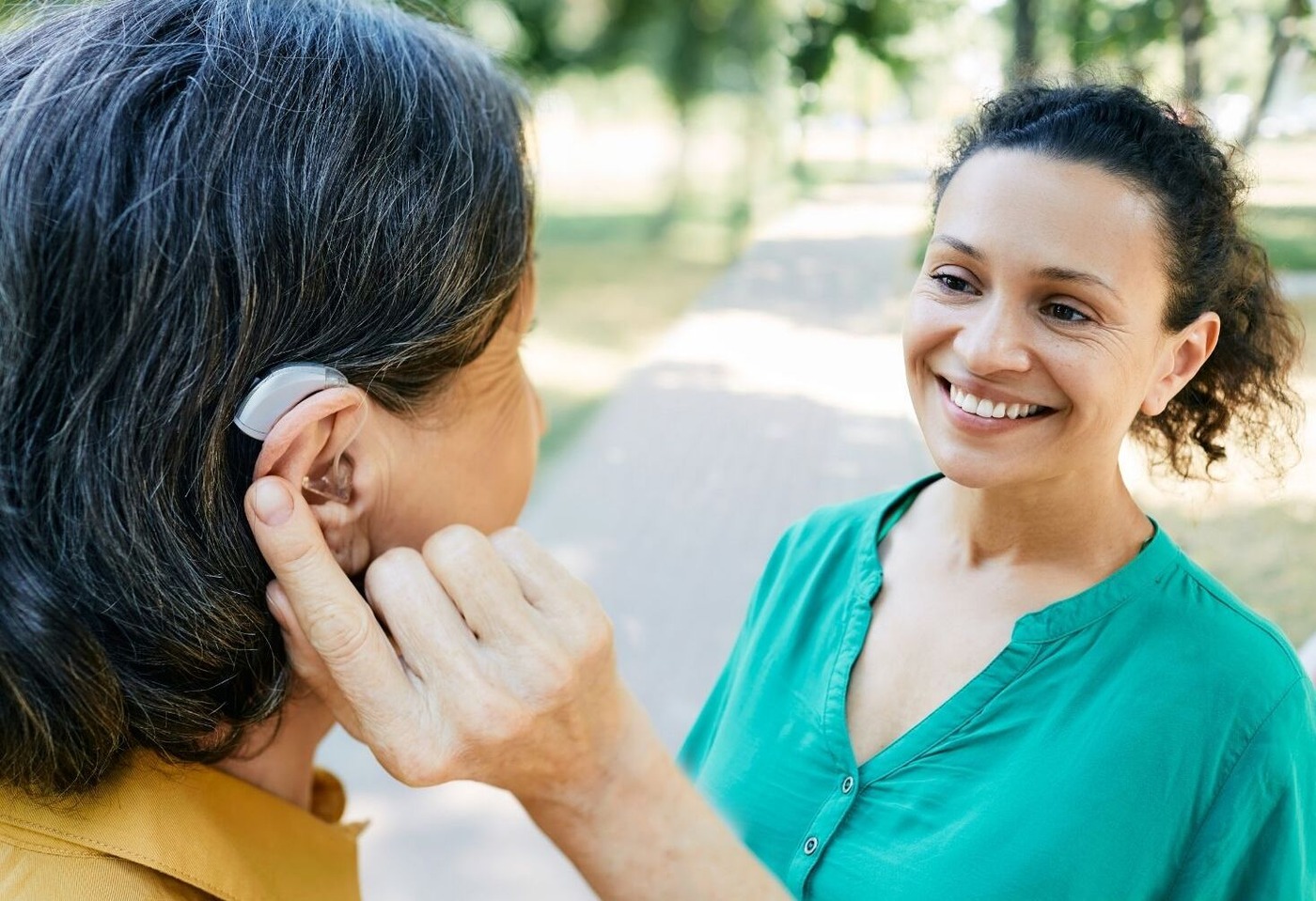
Whether you’re dining out or at a lively gathering, the mix of clattering dishes, overlapping conversations, and background music can make it hard to focus on one voice. For people with hearing loss, that constant stream of sound increases listening effort, leading to fatigue, stress, and social withdrawal over time.
Noise-canceling hearing aids are designed to solve that problem—not by silencing the world, but by helping your brain focus on the sounds that matter most. Unlike basic amplifiers that boost all sounds equally, modern hearing aids use directional microphone arrays, adaptive noise reduction, and AI-based sound processing to identify and emphasize speech while reducing competing noise. The result is clearer, more natural listening in restaurants, crowds, or anywhere sound overlaps.
Below, our audiologists highlight the best hearing aids for background noise in 2025, including both prescription and over-the-counter (OTC) models.
The best noise-canceling hearing aids, compared
- Oticon Real: Best overall
- Sony CRE-E10: Best OTC
- ReSound Nexia: Best prescription
- Phonak Audéo Lumity: Best Bluetooth features
- Starkey Genesis AI: Best battery life
- Lexie Lumen: Best budget
| Category | Brand | Price per pair | Style | OTC or Rx | Hearing loss level | Battery type | Bluetooth | Warranty |
|---|---|---|---|---|---|---|---|---|
| Best overall | Oticon Real | $3,000 to $7,000 | BTE, RITE | Rx | Mild to profound | Rechargeable or disposable | Yes | 3-year |
| Best OTC | Sony CRE-E10 | $899 | ITE | OTC | Mild to moderate | Rechargeable | Yes | 1-year |
| Best prescription | ReSound Nexia | $5,000 to $7,500 | micro-RITE | Rx | Mild to profound | Rechargeable or disposable | Yes | 3-year |
| Best Bluetooth features | Phonak Audéo Lumity | $2,000 to $8,000 | BTE, RITE | Rx | Mild to profound | Rechargeable or disposable | Yes | 1-year |
| Best battery life | Starkey Genesis AI | $2,500 to $7,500 | RITE | Rx | Mild to profound | Rechargeable | Yes | 1-4 year |
| Best budget | Lexie Lumen | $299 | RITE | OTC | Mild to moderate | Disposable | Yes | 1-year |
Oticon Real: Best overall
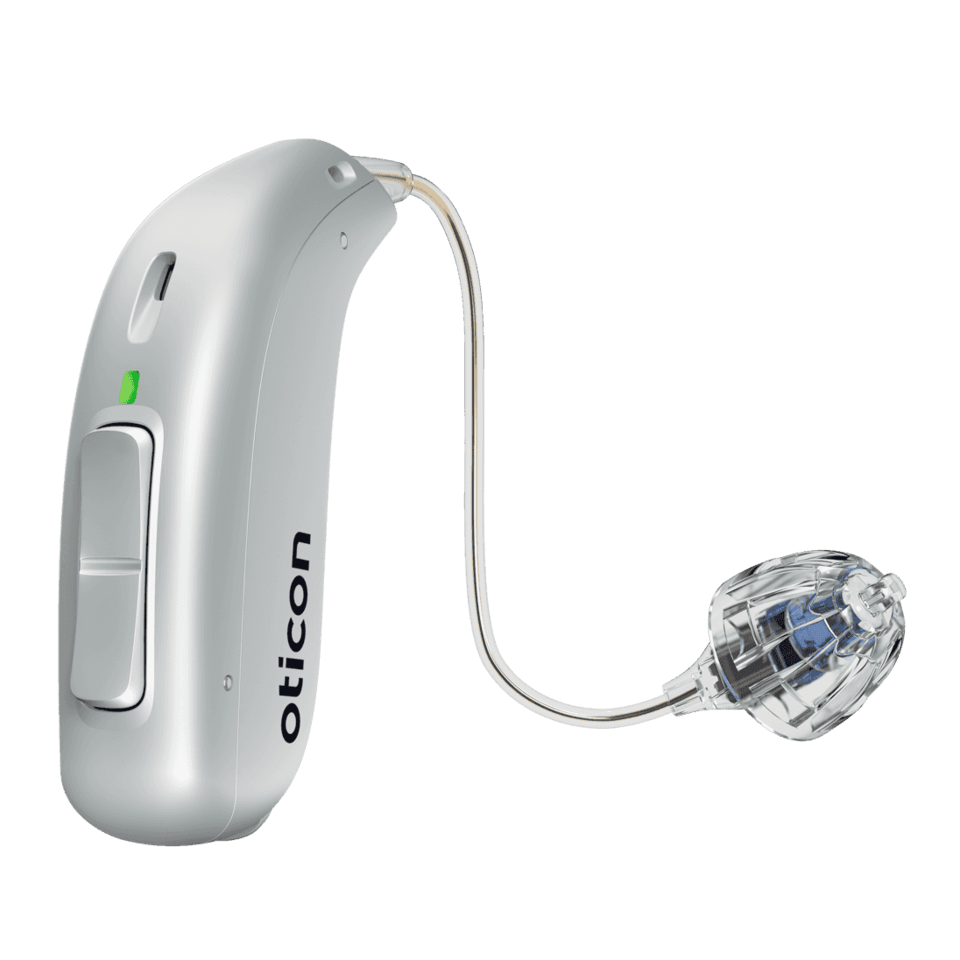
Oticon Real
- $3,000 to $7,000
- Rechargeable or disposable
- Mild to Profound Hearing Loss
Why we picked the Oticon Real
Oticon Real hearing aids from Danish brand Oticon stood out in the pack as the best devices to eliminate background noise, wind, and handling sounds from glasses or hats. These prescription receiver-in-the-ear hearing aids have built-in OpenSound Navigator software that analyzes the wearer’s surroundings and adjusts accordingly for improved speech understanding. The device also utilizes Oticon’s BrainHearing technology to mimic the way our brains interpret sound for a natural listening experience.
It’s offered in 3 technology levels, with the Real 1 being the most advanced when it comes to noise cancellation and the Real 3 being better fit (and cheaper) for those who don’t find themselves in loud settings too often. We also found the Oticon companion mobile app to be user-friendly, allowing you to manage audio levels and EQ for speech and streamed Bluetooth media, as well as track remaining battery life.
Pros of the Oticon Real
- Noise cancellation reduces listening effort
- Delivers natural sound
- Both rechargeable and disposable battery options available
Cons of the Oticon Real
- Expensive
- Users reported mobile app connectivity issues
- Must be fit by an audiologist
What our audiologists say about the Oticon Real
Dr. Ruth Reisman, AuD says: “Oticon’s BrainHearing philosophy emphasizes the importance of considering how the brain processes sound. This approach aims to improve speech understanding, reduce listening effort, and provide a more comfortable and natural listening experience. I mostly fit patients with Oticon devices who have previously worn Oticon and value connectivity.”
Sony CRE-E10: Best OTC
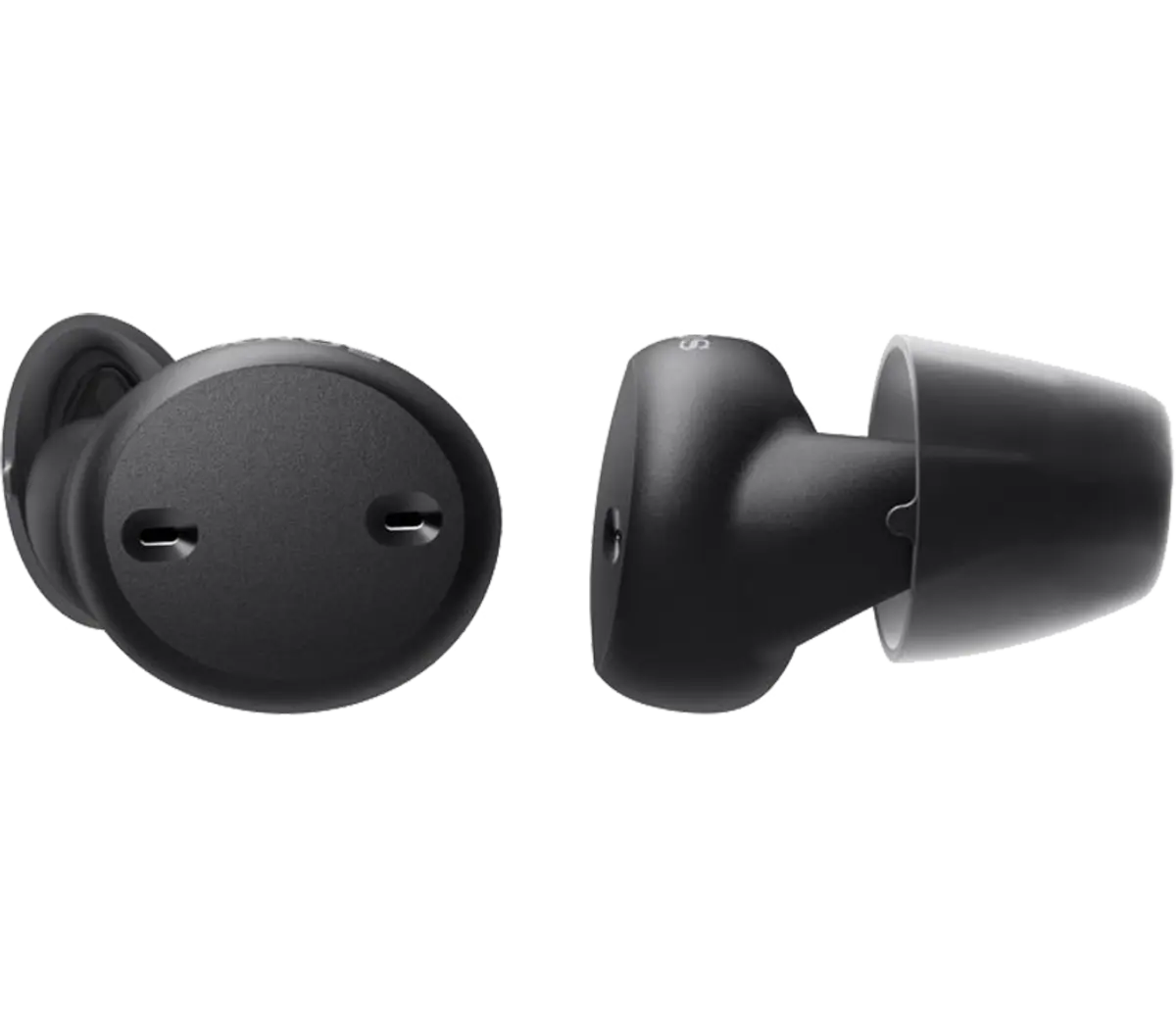
Sony CRE-E10
- $899
- Rechargeable
- Mild to Moderate Hearing Loss
Why we picked the Sony CRE-E10
While prescription hearing aids tend to treat more severe levels of hearing loss, they also tend to be pricier than OTC hearing aids. Developed in tandem with WS Audiology, the CRE-E10 from Sony is a great option for users with mild to moderate hearing loss who are still looking for advanced technology. The in-the-ear (ITE) device closely resembles a traditional earbud headphone and can be worn for up to 26 hours off a single charge in a sleek, portable case. There’s also the compatible Hearing Control mobile app, which features volume control as well as microphone directionality.
But of course, the main feature you’re here to see is its background noise management, which we feel the CRE-E10 more than excels at. The hearing aids automatically adjust noise levels as you move from one environment to the next, saving you from having to recalibrate for different settings.
Pros of the Sony CRE-E10
- Automatic background noise reduction
- Sleek design resembles traditional earbuds
- You can customize from home
Cons of the Sony CRE-E10
- No buttons on physical device to adjust settings
- Small size can be challenging for those with dexterity issues
- Only treats up to moderate hearing loss
What our audiologists say about the Sony CRE-E10
Dr. Jessica Hinson, AuD says: “Sony OTC hearing aids are a simple option for those with mild hearing loss or difficulty in quiet listening situations. To use these devices, you must have and be comfortable with a smartphone. I would not recommend these devices for those with poor dexterity, or those with small ear canals, as they will likely have problems with keeping the aids in the ears. I would not recommend this brand for treating tinnitus.”
Dr. Ruth Reisman, AuD says: “SONY is a trusted brand that partnered with WS audiology, Signia specifically, to provide over the counter devices that offer great discrete reliable solutions to patients who are eligible for the devices based on their hearing thresholds. This can work well for individuals that don’t need a lot of support or a highly individualized solution. The E10 model has the added benefit of directional microphones to further enhance conversations and reduce background noise.”
ReSound Nexia: Best prescription
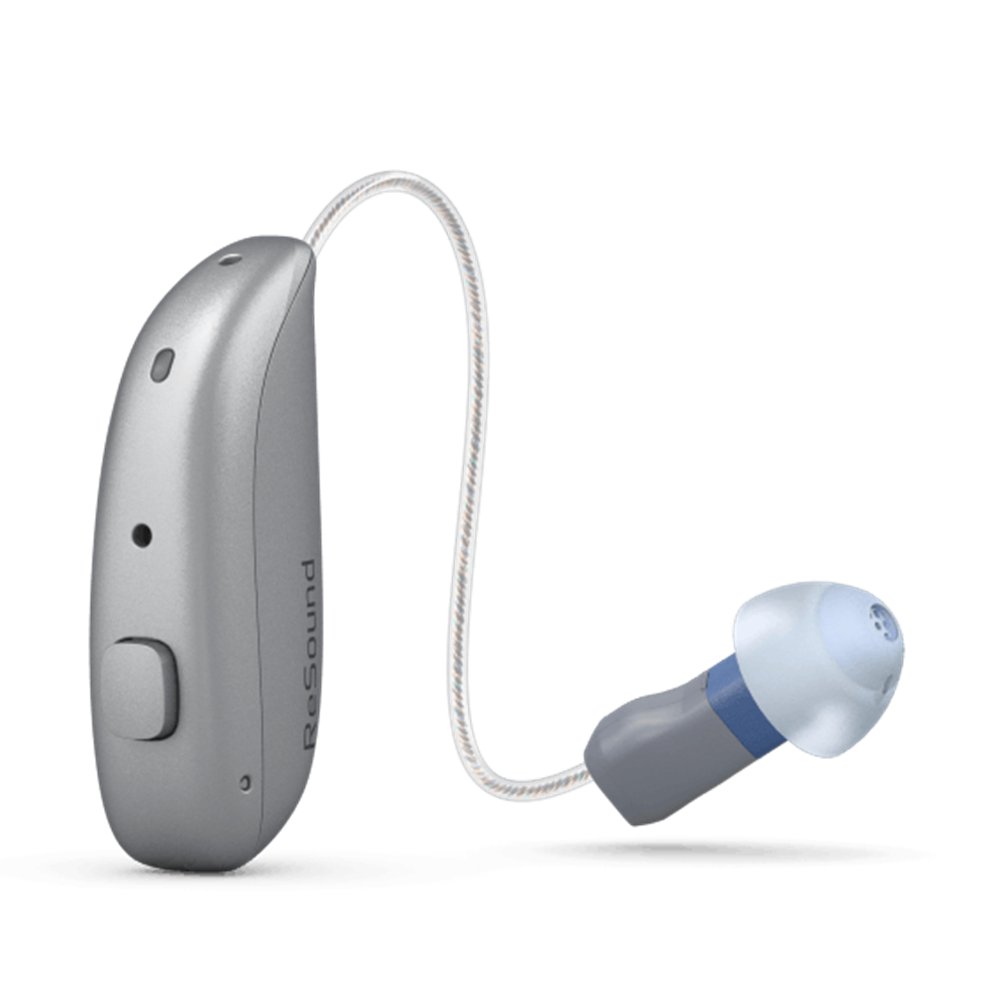
ReSound Nexia
- $5,000 to $7,500
- Rechargeable or disposable
- Mild to Profound Hearing Loss
Why we picked the ReSound Nexia
Since its inception back in the 1940s, ReSound has upended the assistive listening market with a ton of industry firsts. Its latest offering is the prescription Nexia model, the smallest receiver-in-the-ear (RITE) on the market and thus one of the most comfortable ones. This tiny device packs a ton of tech, like a beam-forming microphone that goes directly into your ear to capture and reduce background noise as you’re hearing it. It also works in conjunction with Auracast, a Bluetooth connectivity system that allows you to pair with PA systems in public spaces (similar to a telecoil).
Another benefit? It’s weatherproof, so wearer’s don’t have to worry about damage to their hearing aids if they’re caught in a rainstorm or other inclement conditions. While steep in price, the Nexia certainly merits its value with automatic sound adjustments and streaming capabilities via its highly-rated mobile app.
Pros of the ReSound Nexia
- Small sizes allows for comfortable all-day wear
- Beam-forming microphones reduce background noise
- Compatible with Auracast for public Bluetooth pairing
Cons of the ReSound Nexia
- Expensive
- Lower technology levels (like the Nexia 5) aren’t as effective
- Settings must be calibrated by audiologist
What our audiologists say about the ReSound Nexia
Dr. Jessica Hinson, AuD says: “Great quality product with excellent capabilities. The devices are very durable, easy to manage, and simple to charge. The app is very user friendly and helpful, though the hearing aids make adjustments on their own, so making adjustments through the app is not mandatory or really even necessary.”
Phonak Audéo Lumity: Best Bluetooth features
Phonak Audéo Lumity
- $2,000 to $8,000
- Rechargeable or disposable
- Mild to Profound Hearing Loss
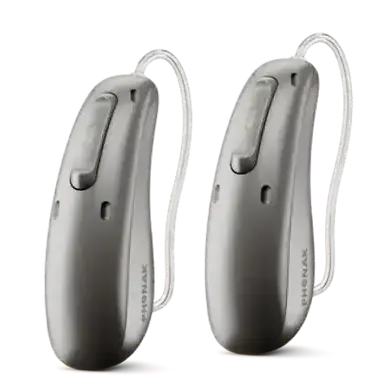
Why we picked the Phonak Audéo Lumity
Another power player in the world of noise-canceling hearing aids is Phonak, whose Audéo Lumity model can detect where speech is coming from and drown out all noise distracting from it via its AutoSense, StereoZoom, and SpeechSensor technology. Users can also make tweaks to the volume and gain by connecting to the Swiss brand’s myPhonak app, which has an impressive 4.4 rating in both the App Store and Google Play.
But with FitBit-esque health tracking and ability to pair with up to eight devices, the Audéo Lumity is best known for its unmatched Bluetooth stability. That combined with its clear, crisp sound makes it no wonder the device is the best-selling prescription hearing aid on the market. It can also be submerged in as much as 20 inches of water, so light swimming is not out of the picture for athletic users.
Pros of the Phonak Audéo Lumity
- Extensive Bluetooth capabilities
- Automatic speech recognition
- Highly-rated mobile app
Cons of the Phonak Audéo Lumity
- Expensive
- Reported hissing noise in quiet environments
- Only 16 hour battery life per charge
What our audiologists say about the Phonak Audéo Lumity
Dr. Jessica Hinson, AuD says: “For background noise reduction, I would recommend the Audeo Lumity 90R. The 90R, the Premium level technology, can handle the most background noise and competing talkers in a given listening situation. The Phonak Audeo Lumity, the latest model of Phonak hearing aids, is Bluetooth compatible with ANY phone with bluetooth capabilities. That means iPhones, Android phones, and even flip phones can work with these aids. They will pair with up to 8 bluetooth devices and two paired at one time (TVs, tablets, even your Peloton!). This is a unique Phonak feature. Phonak RIC models such as the Audeo Lumity are very lightweight, and the receiver is designed to fit securely into the ear, maximizing comfort and retention.”
Starkey Genesis AI: Best battery life
Starkey Genesis AI
- $2,500 to $7,500
- Rechargeable
- Mild to Profound Hearing Loss
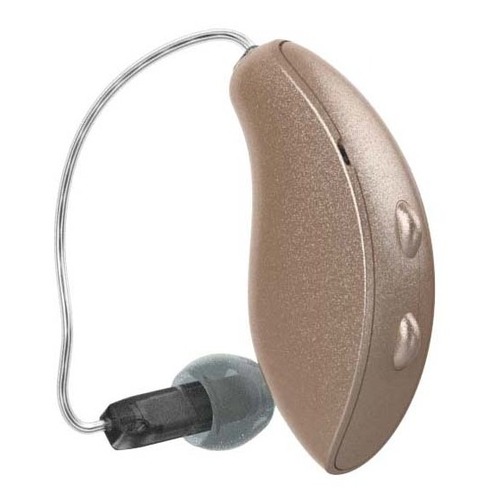
Why we picked the Starkey Genesis AI
If you find yourself in loud environments often, as is the case for construction workers or city dwellers, then you’re going to want hearing aids with ample battery power to get by without having to stop and recharge your device frequently. And when it comes to battery power, there’s no product on the entire hearing aid market with more juice than the prescription Starkey Genesis AI.
On just one single charge, this receiver-in-the-ear (RITE) device boasts 51 hours of battery life in a nearly-invisible, ergonomically-designed unit. The hearing aids mimic your brain’s cerebral cortex to reduce listening effort and provide clarity in loud environments. And although it’s a prescription device, the myStarkey mobile app lets wearer’s personalize their audio settings, saving them trips to the audiologist.
Pros of the Starkey Genesis AI
- Long battery life
- AI software quickly reduces background noise
- Fall detection
Cons of the Starkey Genesis AI
- Expensive
- Mobile app has poor rating in Play Store
- Larger than most RITEs on the market
What our audiologists say about the Starkey Genesis AI
Dr. Ruth Reisman, AuD says: “If you want the most for your buck Starkey hearing aids are definitely the way to go. In addition to improved hearing you get a lot of additional tools including tinnitus management, health tracking, falls alerts, and even language translations. Genesis AI or Evolve AI in the receiver in the canal style that allows for a lot of flexibility in the ear piece to account for ear shape, hearing loss and comfort.”
Lexie Lumen: Best budget
Lexie Lumen
- $299
- Disposable
- Mild to Moderate Hearing Loss
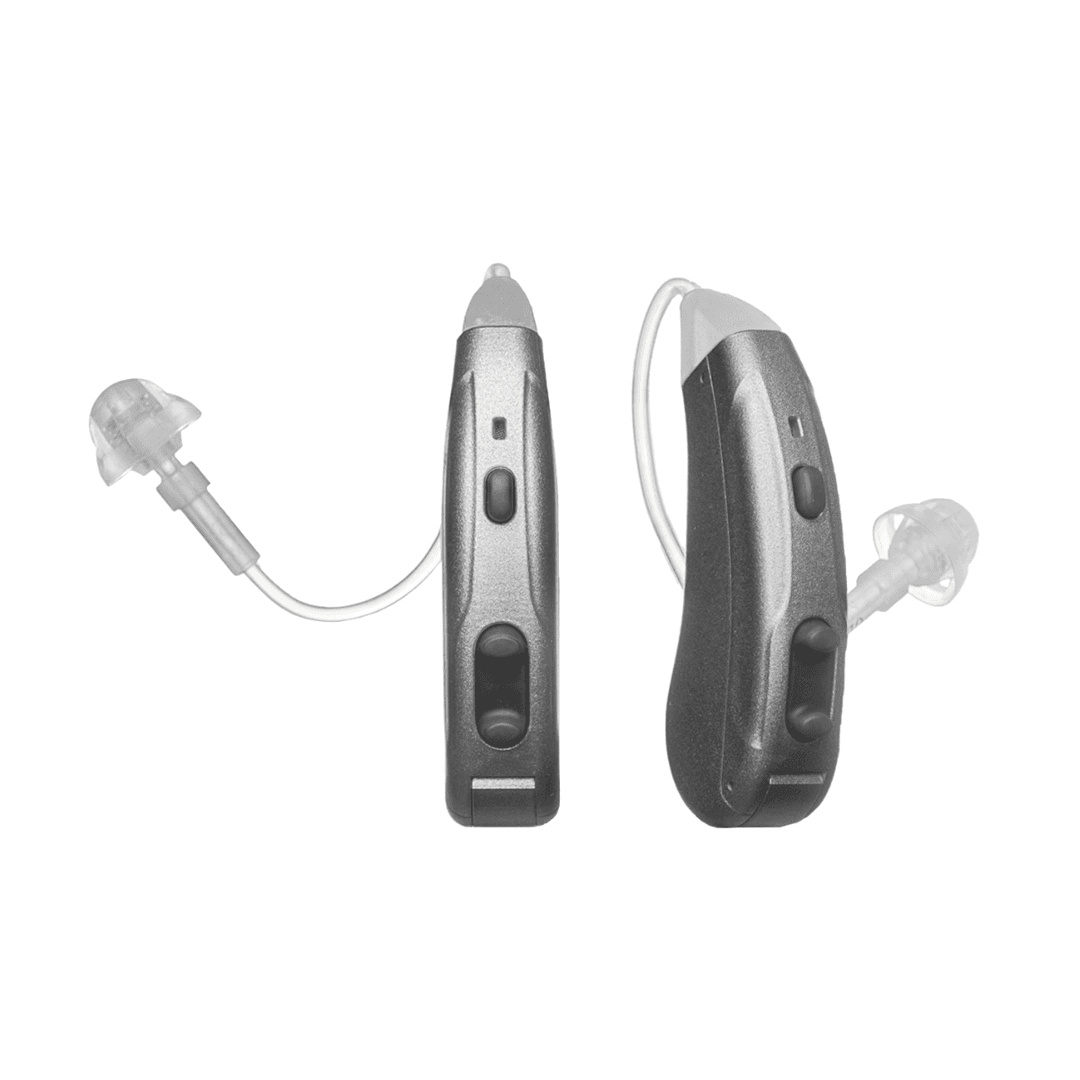
Why we picked the Lexie Lumen
No one can argue with the fact that hearing aids are expensive. And with most insurances not covering such devices, many people with hearing loss would sooner not seek treatment than shell out thousands of dollars on an assistive listening device. That’s why we want to give a special shout out to the Lexie Lumen, an affordable alternative to the pricey prescription noise-canceling hearing aids on the market that doesn’t compromise quality.
The Lexie mobile app has six presets that include “noisy indoor”, “outdoor”, and “music” to filter out background noise. It also comes with an ear measuring tool and multiple dome sizes to fit the device yourself without having to schedule an audiologist appointment. And although there are no rechargeable batteries, the 312 batteries it takes can last up to a week (depending on the severity of hearing loss) before needing to be replaced.
Pros of the Lexie Lumen
- More affordable than most prescription options
- Self-fitting
- Presets include noisy indoor and outdoor environments
Cons of the Lexie Lumen
- Can’t stream music or calls via Bluetooth
- Disposable batteries can be costly and wasteful
- Only treats up to moderate hearing loss
What our audiologists say about the Lexie Lumen
Dr. Ruth Reisman, AuD says: “This can be a great option for someone looking for an affordable behind the ear device with a rechargeable option. It also simplifies technology for the patient without having to deal with a lot of fancy features. Not meant for individuals that want more customization, have severe to profound hearing loss, or want advanced features like Bluetooth streaming.”
Dr. Jessica Hinson, AuD: “Lexie hearing devices are an affordable option for those with mild hearing loss who struggle in quiet environments or in low noise. Lexie has both rechargeable and replaceable battery options, a smartphone app to allow for changes on-the-go, and is backed by Bose (a reputable audio equipment company).”
How noise canceling hearing aids work
To understand how hearing aids work to reduce background noise, it helps to know that modern devices don’t cancel sound the same way headphones do. Instead, they analyze, separate, and clarify it. Rather than simply muting background noise, advanced hearing aids use several different technologies, each targeting a specific kind of sound challenge.
Understanding sound and noise
Every sound you hear has frequency, which is the rate of vibration that determines whether it’s a low rumble or a high-pitched tone. In busy environments like restaurants or parties, dozens of frequencies overlap at once, creating what’s known as ambient noise.
For people with hearing loss, the brain has to work harder to sort speech from that noise. This “listening effort” often causes fatigue and frustration over time.
How modern hearing aids reduce background noise
Entry-level or budget OTC models may use only basic amplification and simple noise filtering, while high-end OTC and prescription devices are likely to combine multiple forms of digital and acoustic processing for a more natural listening experience.
Here are the technologies you’re likely to find in today’s noise-canceling hearing aids:
Digital Signal Processing (DSP)
DSP is found in many, though not all, modern hearing aids. It’s a form of digital technology that captures incoming sound, converts it into data, and runs it through algorithms to identify and reduce unwanted noise.
DSP can:
- Separate speech and noise in real time using adaptive filtering or spectral subtraction
- Minimize distortion while preserving clarity
- Balance gain across frequency bands to emphasize important speech cues
Unlike Active Noise Cancellation, DSP doesn’t create new sound waves, it digitally reshapes existing sound. This makes it ideal for managing complex, high-frequency environments like conversations in restaurants or offices.
Active Noise Cancellation (ANC)
ANC works completely differently. Instead of analyzing digital signals, it uses acoustical phase inversion to physically cancel out sound waves. Tiny microphones detect steady, low-frequency noises (like traffic hum or airplane engines) and generate equal but opposite sound waves to neutralize them.
ANC is most effective for consistent, low-frequency sounds, not fluctuating speech or quick changes in noise. That’s why it’s more common in closed-fit or hybrid hearing aids than in open-fit models, where environmental sound is intentionally allowed to enter.
Directional Microphones
Directional microphones help hearing aids “focus” on what matters most, which is usually the person speaking in front of you. They lower background noise from other directions and improve the signal-to-noise ratio (SNR). Premium devices can switch between narrow or wide focus automatically based on your surroundings.
Digital Noise Reduction (DNR)
DNR systems reduce the gain in frequency ranges dominated by steady noise—like fans, car engines, or air conditioners—without muting important sounds like voices. This improves comfort, reduces listening fatigue, and keeps speech natural.
Artificial Intelligence (AI) and Deep Neural Networks (DNNs)
Advanced hearing aids, such as Starkey Genesis AI and Oticon Intent, use AI-powered DNNs to recognize and adapt to your surroundings. These systems “learn” to distinguish between speech and environmental noise, then automatically optimize clarity in real time. Over time, they even adjust to your personal listening habits.
How we tested noise canceling hearing aids
Our team of audiologists took several criteria into consideration when determining which noise-canceling hearing aids we recommend, including:
- Sound quality. Each of the products in this roundup provides a crisp and clear sound with minimal hissing and feedback.
- Battery life. A hearing aid has to work harder for users with a larger degree of hearing loss, which in some cases is higher in one ear than the other. People who wear assistive listening devices shouldn’t have to worry about losing battery while they’re out and about.
- Ease of use. While some tech savvy people may prefer more advanced hearing aids, we made a point to prioritize easy-to-understand sound settings and mobile apps for the average hearing aid user.
- Cost. We understand that hearing aids are pricey, so we included more budget-friendly over-the-counter (OTC) alternatives to the significantly more expensive prescription devices on this list.
Why trust audiologists.org?
The writers, editors, and staff of audiologists.org know the value of accurate, trustworthy information when it comes to hearing health. Because of this, the content we create is reviewed, approved, and even written by licensed audiologists, guaranteeing that what you read is factual and science-based.
The best noise-canceling hearing aids, compared
Oticon Real: Best overall
Sony CRE-E10: Best OTC
ReSound Nexia: Best prescription
Phonak Audéo Lumity: Best Bluetooth features
Starkey Genesis AI: Best battery life
Lexie Lumen: Best budget
How noise canceling hearing aids work
How modern hearing aids reduce background noise
How we tested noise canceling hearing aids
Why trust audiologists.org?


Frequently asked questions about noise canceling hearing aids
Are there ITE (in-the-ear) noise-canceling hearing aids?
Noise-canceling hearing aids come in a variety of styles, including in-the-ear (ITE), behind-the-ear (BTE), and receiver-in-canal (RIC). However, advanced features like AI-based noise reduction and Bluetooth streaming are more common in RIC and BTE models due to space for extra microphones and processors.
Is a static sound normal with noise canceling hearing aids?
Persistent hissing, static, or feedback in noise-canceling hearing aids may indicate a poor fit, earwax buildup, or a malfunction and should be checked by your audiologist or provider.
What is the technology behind noise-canceling hearing aids?
Most modern hearing aids use Digital Signal Processing (DSP) and Digital Noise Reduction (DNR) algorithms to filter background noise and enhance speech. Some also use Active Noise Cancellation (ANC) to counter steady low-frequency sounds or AI-based learning for adaptive adjustments.
Can noise-canceling hearing aids completely eliminate background noise?
Some noise-canceling hearing aids have better background noise reduction than others, but no hearing aid can eliminate this sound entirely. The goal is to reduce unwanted sounds while preserving speech clarity, especially in conversations and social settings.
Are there hearing aids that separate sounds?
Yes. Devices with directional microphones can focus on speech in front of the wearer while reducing noise from other directions. AI-enhanced models take this further by adapting in real time to different environments.
Can noise canceling be harmful for your ears?
No. Noise-canceling features are designed to make listening more comfortable, not louder. They actually help protect against listening fatigue by reducing the brain’s effort to process competing sounds.