
The Hearing Care Gap: What 400+ Consumers Told Us About Hearing Loss in America
A new audiologists.org survey explores why many Americans who report hearing difficulty still delay hearing tests, audiologist visits, and treatment.


A new audiologists.org survey of more than 400 people offers a window into how consumers are navigating hearing care in the OTC era. Since over-the-counter (OTC) hearing aids became available in 2022, millions of Americans with perceived mild to moderate hearing loss can now purchase hearing aids without a prescription, hearing test, or clinic visit — often at a lower cost than traditional prescription devices. For many consumers, OTC technology has improved accessibility and created a more approachable entry point into hearing care.
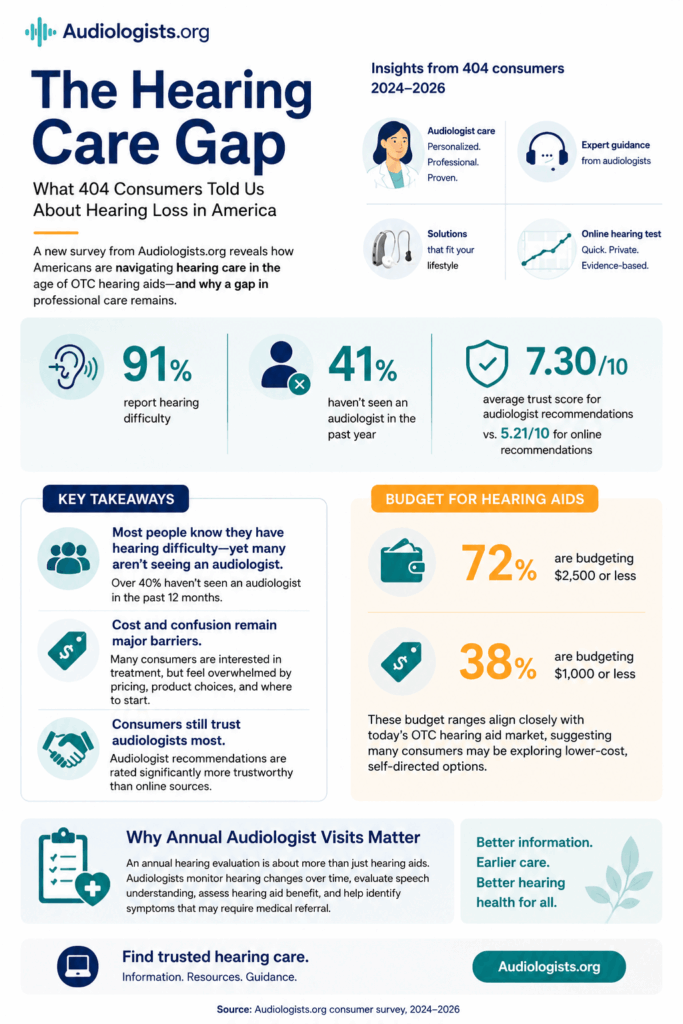
At the same time, the survey findings suggest that many consumers may now be navigating hearing care more independently. About 91% of respondents reported experiencing hearing loss; however, 41% claim they had not seen an audiologist in the past 12 months. That does not necessarily mean these respondents had gone untreated or had not purchased hearing aids. Some may have pursued OTC devices, relied on previous evaluations, or chosen self-directed care pathways instead.
The budget data reinforces that possibility. Among respondents who answered the budget question, roughly 72% said they were budgeting $2,500 or less for hearing aids, and about 38% were budgeting $1,000 or less — price ranges that align closely with today’s OTC market. This suggests many consumers may be exploring lower-cost, self-directed hearing solutions before pursuing traditional clinical care.
Still, the findings are noteworthy because annual hearing evaluations serve a broader purpose than simply purchasing hearing aids. Audiologists help monitor changes in hearing over time, identify medically significant symptoms, evaluate speech understanding, assess hearing aid benefit, and screen for conditions that may require medical referral.
As hearing care becomes more consumer-directed, the survey raises an important question: are more people gaining access to hearing technology while becoming less connected to ongoing professional hearing healthcare?
The 3 key takeaways
- Most respondents reported hearing difficulty — About 91% of survey participants said they have difficulty hearing, yet more than 40% had not seen an audiologist in the past 12 months.
- Cost and confusion remain major barriers — Many respondents appeared interested in treatment but described feeling overwhelmed by pricing, product choices, conflicting information, and uncertainty about where to start.
- Consumers still trust audiologists most — Respondents rated audiologist recommendations significantly more trustworthy than online hearing aid recommendations overall.
The central finding: Nearly all respondents report hearing loss, but many may not be receiving ongoing care
More than 90% of respondents said they have difficulty hearing, and another 4% said they may have difficulty hearing but had not taken a hearing test. The finding suggests that most people who arrived at audiologists.org already had some level of concern about their hearing.
What many had not done recently was seek audiologist care: 40% said they had not seen an audiologist in the past 12 months.
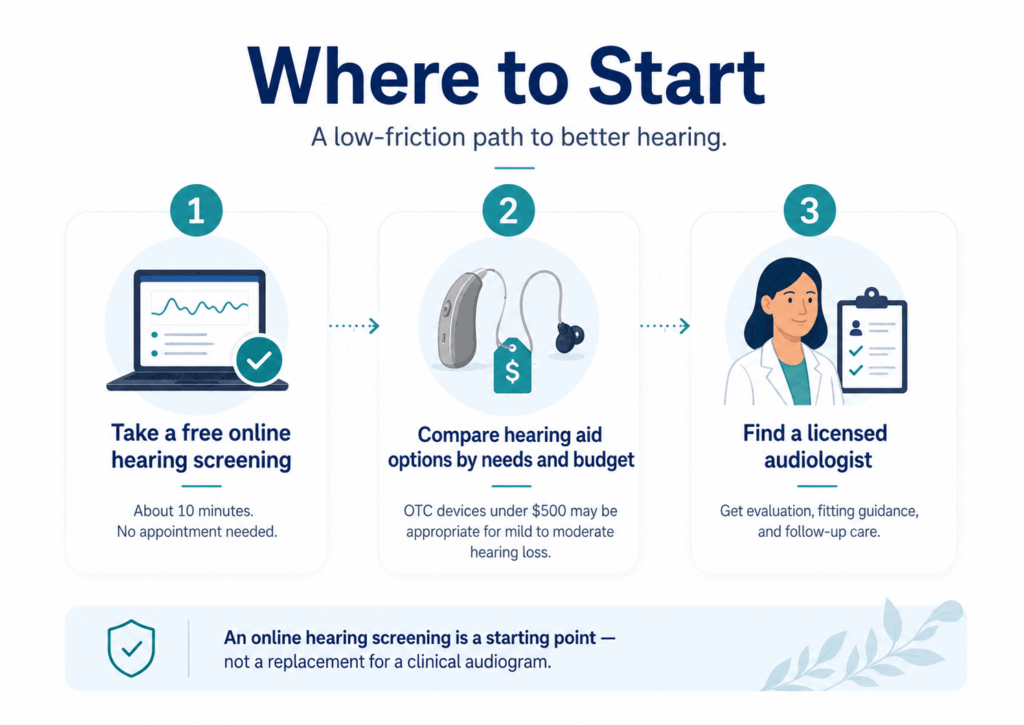
Online hearing tests also appear underused. Nearly 70% of respondents said they had not taken an online hearing test in the previous 12 months. For people who are unsure where to start, an online hearing screening can be a low-friction first step, though it should not be considered a replacement for a clinical audiogram.
While this does not necessarily mean those respondents had gone untreated or had never sought care, it does suggest that a meaningful share of people researching hearing information online may not be receiving ongoing professional hearing healthcare. Some may instead be pursuing OTC hearing aids or other self-directed care pathways.
Others, however, may still be delaying treatment altogether — a longstanding pattern in hearing healthcare. It’s a commonly cited hearing loss statistic that people wait an average of 7 years before seeking help for hearing loss, and often more than 9 years between diagnosis and obtaining their first hearing aid.
Why annual hearing tests matter
That trend is noteworthy because about 75% of survey respondents were age 71 or older — an age group where hearing loss becomes increasingly common and annual hearing tests are recommended. National data suggests this gap in receiving an audiological evaluation extends beyond our survey respondents. In a University of Michigan National Poll on Healthy Aging, only about 23% of adults ages 50–80 reported having a hearing test by a healthcare professional within the previous two years.
Hearing evaluations do more than determine candidacy for hearing aids. Audiologists monitor changes in hearing over time, assess speech understanding, evaluate device benefit, and help identify symptoms that may require medical referral. Untreated hearing loss has also been associated with broader health risks, including cognitive decline, depression, and social isolation.
Why many consumers hesitate to seek hearing care
Most respondents reported hearing difficulty, and many appeared to be actively researching hearing aids, reading reviews, comparing brands, or looking for professional guidance. Yet a substantial share had not recently seen an audiologist or taken an online hearing test.
Rather than simple inaction, the data points toward hesitation. Many consumers appear aware of the problem, interested in solutions, but uncertain about cost, credibility, product quality, and where to begin.
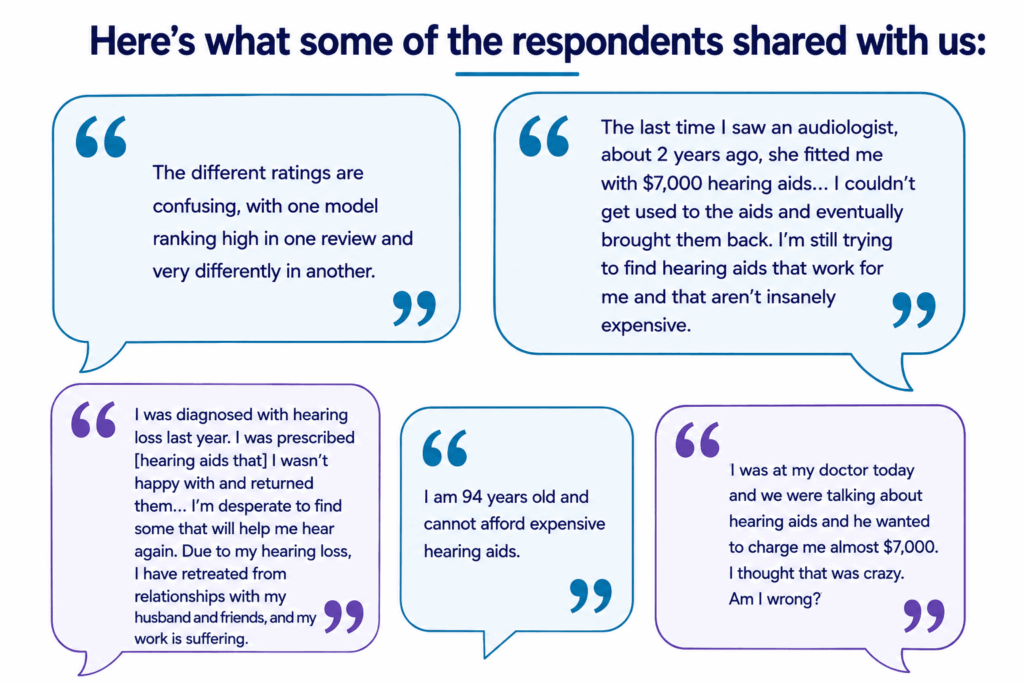
The open-text responses reinforce this interpretation. Respondents repeatedly described confusion around conflicting reviews, skepticism about pricing, frustration with prior hearing aid experiences, and uncertainty about which providers or devices to trust.
Cost concerns remain a major barrier
While the survey did not directly ask respondents why they had not recently seen an audiologist, cost concerns appeared repeatedly throughout the open-text responses. Respondents described frustration with the price of hearing aids, skepticism about whether the cost reflects real value, and in some cases, clear financial limitations.
These responses align with broader hearing health research, including an earlier audiologists.org consumer survey where 73% of respondents identified cost as a major barrier to hearing care and hearing aid adoption.
Member of our medical advisory team, Dr. Ruth Reisman, AuD, explains that hearing aid pricing reflects both the technology itself and the professional care required to achieve the best outcomes:
“Hearing aids can be costly because they are not simply amplifiers. They are sophisticated medical devices that are individually programmed and adjusted to match a patient’s specific hearing needs. The cost also reflects the professional services provided by the audiologist, including diagnostic testing, fitting, counseling, follow-up care, and ongoing support to ensure optimal communication outcomes. Modern hearing aids also include advanced features such as noise reduction, wireless connectivity, rechargeable technology, and artificial intelligence.”
It’s also important to understand that hearing aid pricing can vary depending on the type of device and care model. Over-the-counter (OTC) hearing aids are generally self-fit for adults with perceived mild to moderate hearing loss, while prescription (RX) hearing aids are professionally fit and customized by an audiologist. Additionally, some clinics use bundled pricing, which combines the devices and professional services into one fee, while others use unbundled pricing that separates the cost of the hearing aids from follow-up audiologic care and support.
Hearing aid budget expectations suggest growing OTC interest
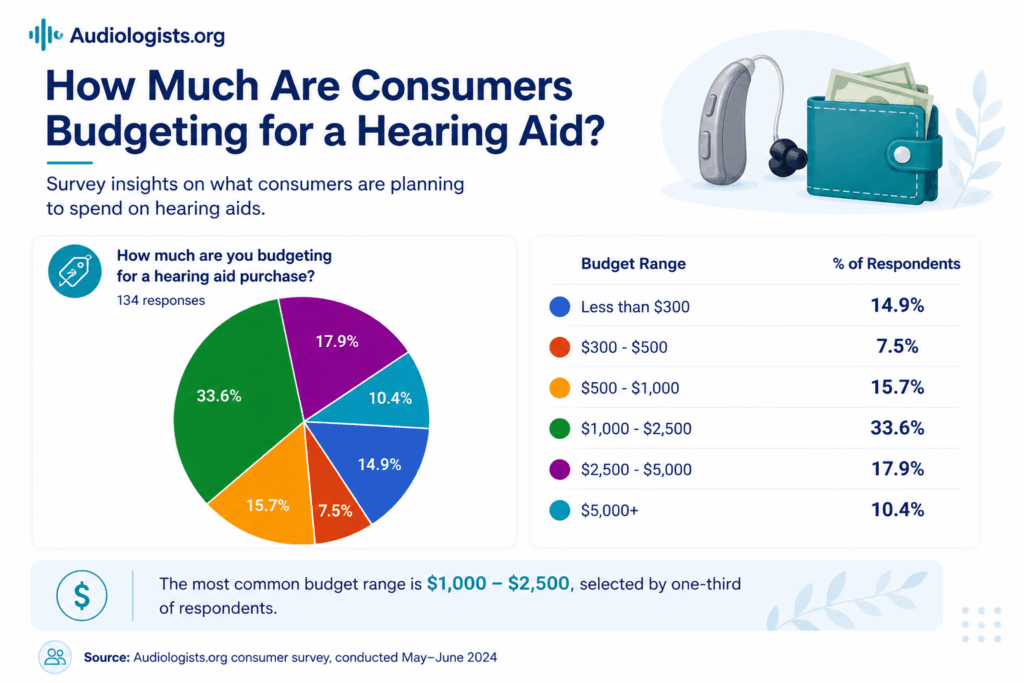
Among respondents who answered the hearing aid budget question, the most common budget range was $1,000–$2,500, selected by about 34% of respondents. Overall, about 72% said they were budgeting $2,500 or less, while roughly 38% were budgeting $1,000 or less.
Those price ranges closely align with today’s OTC hearing aid market, where many devices cost substantially less than traditional prescription hearing aids. The findings suggest some consumers may be exploring lower-cost or self-directed treatment pathways before pursuing traditional clinical care.
Consumers are searching for trustworthy guidance
Beyond cost, the survey also revealed a strong demand for trustworthy, easy-to-understand information.
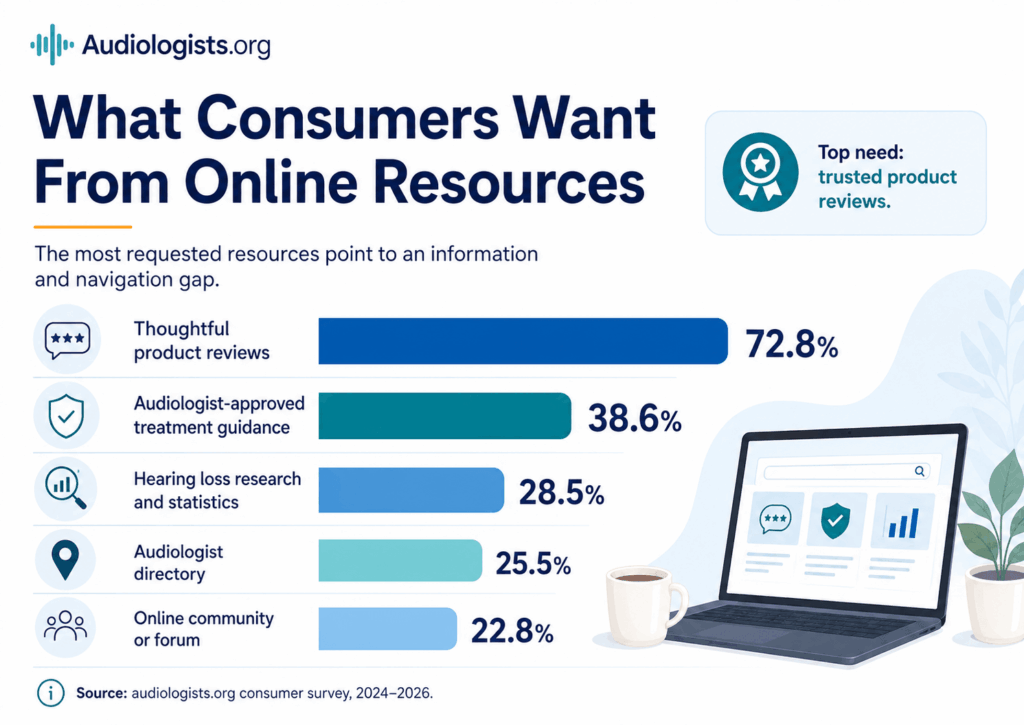
When respondents were asked what resources would be most helpful, about 73% selected thoughtful hearing aid reviews, followed by audiologist-approved treatment guidance at 39%, hearing loss research and statistics (28%), an audiologist directory (25%), and an online hearing-loss community or forum (22.8%).
The pattern suggests many consumers are not indifferent to their hearing health — they are overwhelmed by the number of options, conflicting claims, and difficulty identifying sources they can trust. Many appear to be searching not just for hearing aids, but for credible guidance to help them navigate an increasingly complex hearing-care landscape.
The trust paradox: consumers still trust audiologists more than online sources
Perhaps the most revealing finding in our survey involved trust. We asked respondents to rate the trustworthiness and helpfulness of hearing-loss resources and hearing aid recommendations from both audiologists and online sources on a scale of 1–10.
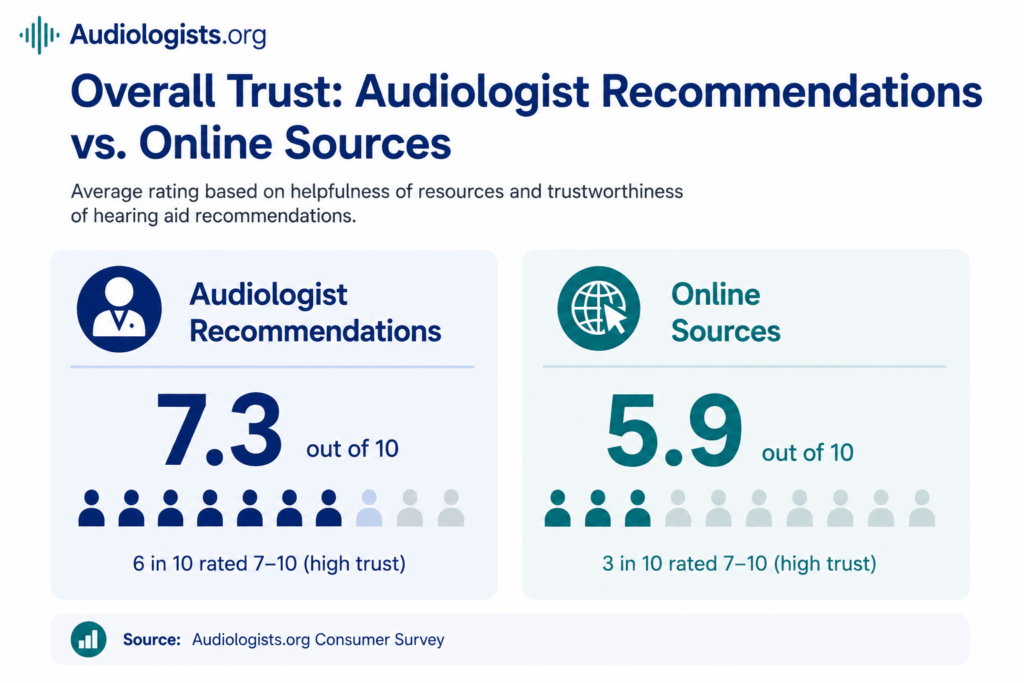
Across both categories, respondents consistently rated audiologists as more trustworthy and helpful than online sources, despite many not having seen an audiologist in the past year. Audiologists received average scores of about 7.3 out of 10, compared with roughly 5–6 out of 10 for online sources.
Perception of helpfulness in providing resources:
- Audiologist: 7.22/10
- Online: 6.12/10
Perception in trustworthiness when recommending hearing aids:
- Audiologist: 7.32/10
- Online: 5.32/10
*mean scores
Why this matters
This matters for how we understand the care gap. Among the barriers to accessing professional hearing health care, distrust of audiologists does not appear to be one of them. People who are deferring care are not doing so because they doubt their audiologist’s expertise or integrity. More often, cost, convenience, uncertainty about how to begin, or overwhelm around options is keeping them from crossing the threshold.
The findings suggest consumers value the convenience and accessibility of online hearing information, but still place significantly greater confidence in professional guidance when making hearing-care decisions.
This means that if hearing care becomes easier to navigate, more affordable, and lower friction to access, more people may feel comfortable taking the first step toward treatment earlier.
What this means for anyone who has been putting off getting help
If you relate to our survey participants — or to the many Americans who suspect hearing loss but have delayed taking action — we want you to know that the first step may be easier than you think.
- A free online hearing screening is a great place to start and typically takes less than 10 minutes. It does not replace a clinical audiogram, but it can provide a baseline sense of your hearing and help you decide whether a more comprehensive evaluation makes sense.
- If cost has been the sticking point, the OTC hearing aid market has changed the equation considerably. Devices that have been tested and reviewed by our board of licensed audiologists are available at a range of price points — including hearing aid options under $500 that provide genuine value for mild to moderate hearing loss. Our Best Hearing Aids of 2026 and Best OTC Hearing Aids of 2026 guides include price comparisons across every budget range, with plain-language guidance on who each device is and isn’t appropriate for.
- If you have been waiting to find the right audiologist, the audiologists.org provider directory allows you to search by location and specialty.
Hearing loss that goes unaddressed does not necessarily remain static. Research has linked untreated hearing loss with increased risk of social isolation, depression, and cognitive decline in older adults. While hearing treatment cannot prevent every downstream health outcome, growing evidence suggests that earlier identification and intervention may help support communication, quality of life, and long-term health. And the barriers, in many cases, are not as insurmountable as they may appear.
Who we surveyed
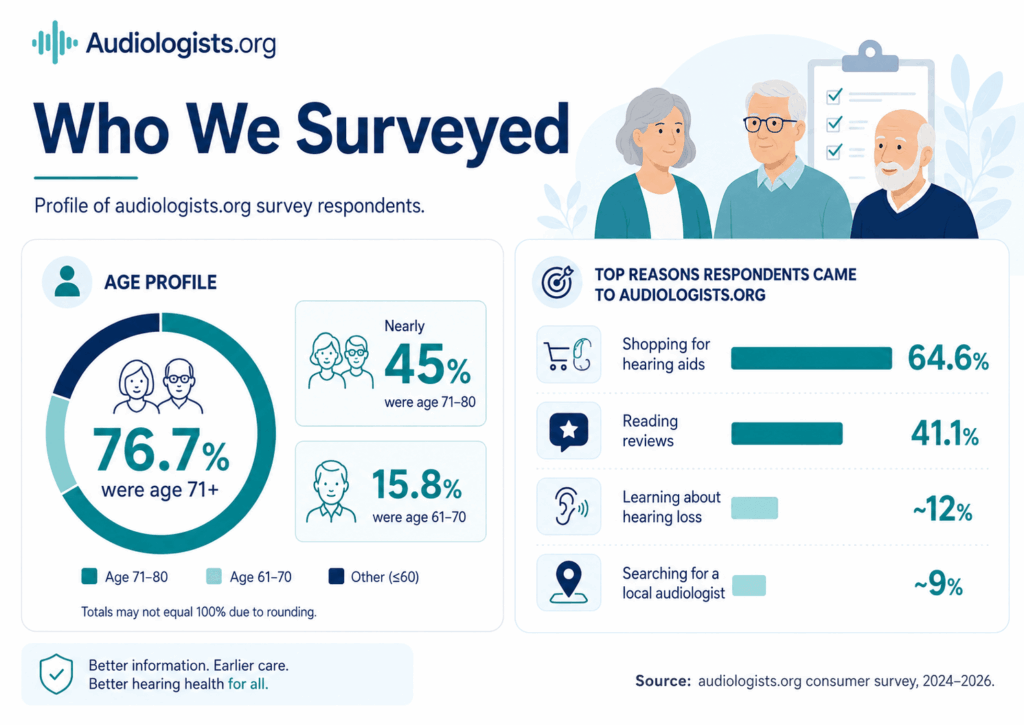
Our survey captured responses from 404 consumers across a range of ages and stages of the hearing health journey. The demographic profile reflects who is most actively seeking hearing care information online: 76.7% of respondents were age 71 or older, with the single largest group — nearly 45% — falling between the ages of 71 and 80. Respondents aged 61 to 70 made up another 15.8% of the sample.
Most respondents came to audiologists.org with a clear informational or shopping-related purpose. About 64.6% said they visited the site to shop for hearing aids, while 41.1% came specifically to read reviews. Roughly 12% came to learn more about hearing loss, and about 9% were searching for a local audiologist.
These aren’t passive browsers. They were motivated consumers actively navigating decisions that are medically important, emotionally significant, and financially consequential.
Methodology
This data was collected via a consumer survey distributed through audiologists.org via email and lead magnet between November 2024 and May 2026. A total of 404 responses were captured. The survey was offered to adults who visited audiologists.org or engaged with audiologists.org email communications; it was not administered to a probability-based population sample and should not be interpreted as nationally representative. Percentages are calculated from the full respondent pool unless otherwise noted. Budget data was provided by 134 respondents; analysis of hearing aid budget expectations is limited to that subgroup.
Trust and helpfulness scores were collected on a 1–10 scale. Scores of 7–10 are characterized as “high” and scores of 1–4 as “low.” Paired trust-score comparisons between audiologists and online resources were available for 387 respondents.


Frequently asked questions
How often should older adults have their hearing checked?
Hearing-health recommendations vary based on age, risk factors, and symptoms, but many audiologists recommend annual hearing evaluations for older adults — particularly those over age 70 or anyone noticing changes in hearing, communication, or tinnitus. Regular testing can help identify changes earlier and establish a baseline for monitoring hearing over time.
What are the signs that hearing loss may be affecting daily life?
Common signs of hearing loss include asking people to repeat themselves frequently, struggling to follow conversations in background noise, increasing TV volume, withdrawing from social situations, or feeling mentally fatigued after conversations. Some people also notice frustration, isolation, or difficulty hearing on the phone before they recognize the extent of their hearing loss.
How many people have untreated hearing loss in the United States?
According to the National Institute on Deafness and Other Communication Disorders (NIDCD), approximately 37.5 million American adults report some degree of hearing difficulty Despite that prevalence, hearing treatment remains underutilized. NIDCD reports that among adults age 70 and older who could benefit from hearing aids, fewer than 30% have ever used them. That broader treatment gap was reflected in our survey findings, where many respondents reported hearing difficulty but had not recently seen an audiologist or taken an online hearing test.
Why do so many people delay getting a hearing test?
Research and consumer survey data consistently point to cost, perceived inconvenience, and a sense that hearing is still “good enough.” Our survey adds another layer: many respondents appeared interested in treatment, but overwhelmed by conflicting reviews, pricing confusion, and uncertainty about where to begin or which resources to trust.
Can an online hearing test replace a clinical audiogram?
No. An online hearing screening can provide a useful baseline indication of hearing ability and help you decide whether a professional evaluation is warranted, but it cannot replicate the diagnostic precision of an in-person audiogram administered by a licensed audiologist in a controlled environment. Think of an online test as a screening tool and starting point, not a diagnosis.
Are OTC hearing aids a legitimate option for people who haven't seen an audiologist?
For adults age 18 and older with perceived mild to moderate hearing loss, yes. The FDA’s 2022 OTC hearing aid ruling created a regulated category specifically for that population. OTC hearing aids do not require a prescription, hearing test, or professional fitting. However, they are not intended for severe or profound hearing loss, sudden hearing changes, or pediatric use. If you are unsure about your hearing level or symptoms, an online screening or diagnostic hearing test is a good first step before choosing a device.