
How audiologists work with other specialists
Why audiologists partner with ENTs, SLPs, and other specialists to deliver complete hearing, balance, and communication care

Who do audiologists work with?
Audiology and ENT
Audiology and speech-language pathology
Audiology and neurology
Audiology and geriatric care
Audiology and oncology
Audiology and physical therapy
Audiology and mental health
Audiology in school-based teams
From an audiologist: what collaborative care looks like in practice
What team-based care means for patients
Conclusion

Audiologists work with a range of healthcare professionals to diagnose, treat, and manage hearing and balance conditions. This team may include ENT doctors, speech-language pathologists (SLPs), primary care providers, and other specialists depending on a patient’s needs. Each provider plays a different role, and together they form a hearing care team that delivers more complete, coordinated care.
In practice, audiologists focus on evaluating hearing and balance, managing hearing technology, and guiding rehabilitation. When additional medical, communication, or balance-related support is needed, they collaborate with other specialists to ensure every aspect of a patient’s condition is addressed.
Understanding how audiologists work with other healthcare professionals helps patients anticipate what their care team might look like, helps practitioners appreciate the referral relationships that serve their patients best, and reveals the team-based approach that underlies some of audiology’s most important clinical work.
The 3 key takeaways
- Hearing care is team-based: Audiologists work within a broader hearing care team that includes ENTs, SLPs, and other specialists.
- Each provider plays a distinct role: Audiologists diagnose and manage hearing, while other providers address medical, rehabilitative, and cognitive needs.
- Better coordination leads to better outcomes: Team-based care improves communication, treatment efficiency, and long-term quality of life.
Who do audiologists work with? (hearing care team overview)
Audiologists are healthcare professionals who diagnose, manage, and treat hearing and balance disorders — and they do this as part of a broader hearing care team.
In practice, audiologists are responsible for:
- Evaluating hearing and balance (hearing tests, vestibular assessments)
- Diagnosing hearing loss and auditory disorders
- Managing hearing technology (hearing aids, cochlear implants)
- Providing rehabilitation and counseling
- Monitoring hearing over time
Even when an audiologist has advanced training or a specialty, hearing and balance conditions often involve medical, communication, and cognitive factors that are outside an audiologist’s scope of practice. Collaboration with other specialists is what allows for complete, team-based care.
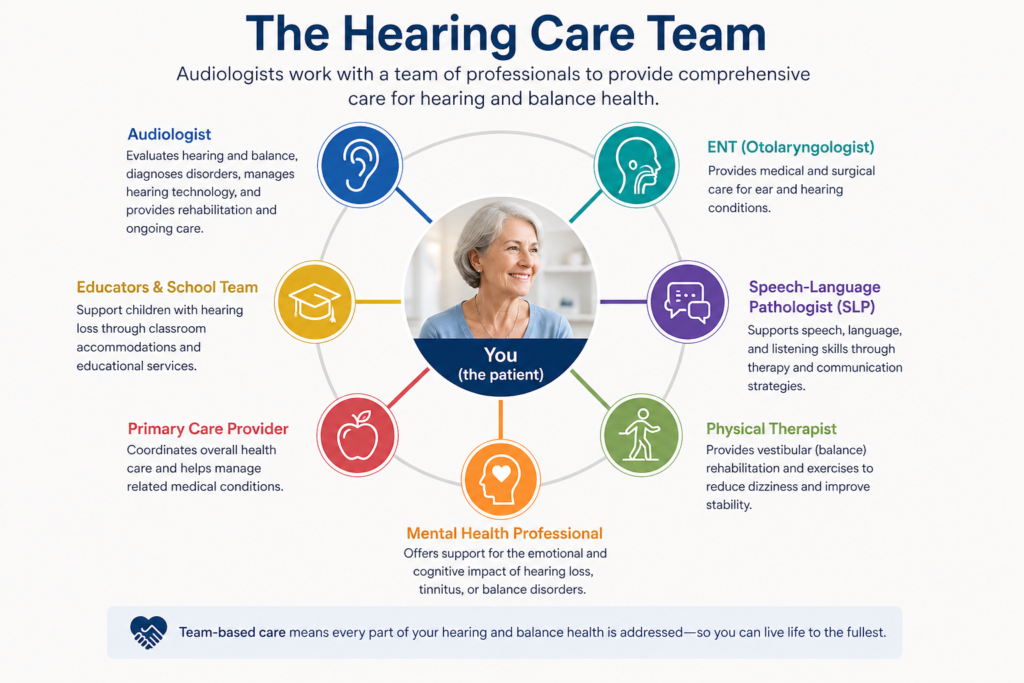
Common professionals in the hearing care team
- ENT doctors (otolaryngologists) — medical and surgical treatment
- Speech-language pathologists (SLPs) — speech, language, and auditory rehab
- Primary care physicians — referrals and overall health coordination
- Neurologists — brain and nerve-related hearing conditions
- Physical therapists — vestibular (balance) rehabilitation
- Psychologists or counselors — emotional and cognitive support
- Educators and school teams — support for children with hearing loss
- Hearing instrument specialists — hearing aid support in some settings
This team-based care model ensures patients receive treatment that addresses both the medical and functional effects of hearing loss.
Audiology and ENT (otolaryngology): the core partnership
The most fundamental and complimentary partnership in hearing healthcare is between audiologists and ENT (ear, nose, and throat physicians) physicians.
Audiologists focus on diagnosing hearing loss through detailed testing which guides treatment. However they can not prescribe medications, treat medical conditions, or perform surgery. If that’s needed, that’s where an ENT steps in.
When an audiologist identifies findings that suggest a medical issue—such as middle ear disease, structural abnormalities, or sudden sensorineural hearing loss—a referral to an ENT is essential.
The ENT then evaluates the medical or surgical dimensions of the finding, may order imaging, and determines whether intervention is indicated. Post-medically, the patient often returns to the audiologist for hearing rehabilitation, device fitting, or ongoing monitoring.
In clinical settings where audiologists and ENTs work together within the same practice or hospital department, this collaboration is seamless and continuous. In settings where they practice separately, it depends on strong referral communication — detailed reports, shared records, and the mutual professional respect that enables efficient handoffs without gaps in patient care.
Sudden sensorineural hearing loss is the sharpest example of why this partnership matters. It is a medical emergency — a condition where prompt corticosteroid treatment can meaningfully affect outcomes, and where delay reduces the window for intervention. An audiologist who evaluates a patient presenting with sudden unilateral hearing loss and refers immediately to an ENT or emergency care is practicing the collaboration that the condition demands.
Audiology and speech-language pathology (SLP): how they work together
The relationship between audiology and speech-language pathology (SLP) is the profession’s oldest and most structurally embedded collaboration — the two disciplines share their primary professional organization (ASHA), train in overlapping academic programs, and regularly care for the same patients, particularly children.
In pediatric hearing healthcare, this collaboration is often continuous and intensive. When a child is identified with hearing loss through newborn screening or later evaluation, the audiologist determines the type, degree, and configuration of the loss, fits the hearing technology, and monitors audiological status over time. The SLP assesses the child’s language and speech development, provides direct therapy, and helps the family support communication development at home. Their coordinated care directly shapes the child’s developmental trajectory.
In cochlear implant programs, audiology manages device fitting, mapping, and audiological monitoring. SLP provides the therapy that helps implant recipients develop meaningful speech perception and expressive communication with their new device. Without this rehabilitation component, access to sound does not automatically translate into meaningful communication.
Patients of all ages can benefit from this partnership, including those participating in auditory rehabilitation programs or managing conditions like tinnitus.
Audiology and neurology
The connection between audiology and neurology becomes more visible in complex cases involving the brain and auditory system.
Conditions such as auditory neuropathy spectrum disorder, acoustic neuromas, central auditory processing disorder, tinnitus with neurological features, and hearing changes related to brain injury or neurological disease often require input from both specialties. Audiologists identify functional hearing issues, while neurologists investigate underlying neural or systemic causes and broader neurological implications.
Audiology and geriatric care
Hearing loss in older adults is closely linked to cognitive health, social engagement, and fall risk. In this context, audiologists often work as part of a broader care team that may include geriatricians, primary care providers, and caregivers.
As the connection between hearing loss, cognitive decline, social isolation, and fall risk in older adults has become better established, audiology’s collaboration with geriatric medicine has deepened. Audiologists working in geriatric settings — VA medical centers, memory care programs, hospital geriatric consultation services — increasingly function as part of interdisciplinary care teams that include geriatricians, neuropsychologists, occupational therapists, social workers, and primary care physicians.
In a geriatric context, hearing loss is rarely the only issue. A patient presenting for audiological evaluation may also have mild cognitive impairment that affects how they respond to hearing tests, how they manage hearing aids, and how much support they need from family caregivers.
Hearing loss is often one part of a larger health picture. Coordinated care ensures that treatment plans reflect not only hearing needs but also cognitive and physical considerations.
Audiology and oncology (ototoxicity monitoring)
Some cancer treatments, particularly certain chemotherapy drugs, can damage hearing.
The relationship between audiology and oncology is primarily organized around ototoxicity — medication-induced hearing loss that is dose-dependent, cumulative, permanent, and frequently severe enough to require hearing aids or cochlear implants in affected patients.
Audiologists who provide ototoxicity monitoring services work in direct coordination with the oncology team. The audiologist establishes baseline hearing before treatment, conducts monitoring evaluations at defined intervals during the treatment course, and communicates findings promptly when significant threshold shifts are detected. The oncologist makes decisions about any necessary treatment modification in response to that information.
By identifying early changes in hearing, audiologists can help oncology teams preserve hearing while maintaining effective cancer care.
Audiology and physical therapy (vestibular rehab)
Balance disorders often require coordinated care between audiologists and physical therapists.
Audiologists diagnose vestibular (balance) dysfunction through specialized testing, while physical therapists design and implement exercise-based treatment programs that help reduce dizziness and improve balance. This partnership is especially important for conditions like BPPV, Ménière’s disease, and chronic dizziness.
For patients with benign paroxysmal positional vertigo (BPPV), the most common vestibular disorder, the audiologist may perform the initial repositioning procedure (Epley maneuver) that resolves the acute vertigo. For patients with more complex or chronic vestibular conditions, ongoing rehabilitation with a physical therapist is typically the primary management strategy, guided by the audiologist’s assessment findings.
Audiology and mental health
The mental health consequences of hearing loss — including depression, anxiety, social withdrawal, and the grief that can accompany a significant hearing loss diagnosis — mean that audiologists increasingly recognize the value of collaboration with mental health professionals in the care of their patients.
Tinnitus is perhaps the clearest example. For patients with tinnitus that produces significant emotional distress, the evidence base for Cognitive Behavioral Therapy (CBT)-informed approaches is strong and growing.
In settings where audiologists and psychologists or counselors work collaboratively, patients receive both the audiological management (sound therapy, hearing aid fitting, education about the neuroscience of tinnitus) and the psychological support (cognitive restructuring, anxiety management, sleep strategies) that the most comprehensive tinnitus programs provide. Neither dimension alone is as effective as both together.
In practice, audiologists may use tools like the Tinnitus Handicap Inventory (THI) to assess how significantly tinnitus is affecting a patient’s quality of life; higher scores often help guide referrals to mental health providers.
More broadly, audiologists who identify patients struggling with the emotional dimensions of hearing loss are well-served by having mental health referral pathways available.
In some cases, referral is more urgent. Patients expressing severe distress, depressive symptoms, or suicidal ideation related to tinnitus require prompt coordination with mental health providers.
In pediatric and adolescent populations, referrals may also occur for different reasons. For example, when testing reveals inconsistent or non-organic hearing loss (sometimes called malingering), audiologists may refer patients to psychologists to better understand underlying behavioral or emotional factors.
The audiologist is not a therapist, but recognizing when a patient’s needs extend into that domain, and facilitating appropriate referral, is part of patient-centered interdisciplinary care.
Audiology in school-based teams (IEP care)
In educational settings, audiology’s collaborative relationships are formalized through legal structures. The Individuals with Disabilities Education Act (IDEA) requires that children with disabilities — including hearing loss — receive services from a coordinated team of professionals as part of the Individualized Education Program (IEP) process. The IEP team for a student with hearing loss typically includes the educational audiologist, a teacher of the deaf or hard of hearing, a speech-language pathologist, the student’s classroom teachers, special education coordinators, school administrators, and the family.
The educational audiologist’s contribution to this team includes characterizing the student’s hearing, identifying the listening technology needed to support learning, conducting classroom acoustic assessments, troubleshooting device issues, and educating teachers on how to communicate effectively with students who have hearing loss.
This coordinated approach ensures that children with hearing loss receive the support they need for both communication and academic success.
From an audiologist: what collaborative care looks like in practice
Jessica Hinson, Au.D., shares her perspective as a practicing audiologist working closely with ENTs, therapists, and other specialists across the continuum of care:
“Understanding the importance of collaborative care begins in graduate school. Prospective audiologists must complete a course on interdisciplinary studies, shadow different disciplines, and report on their findings and how those specialties relate to the audiology clinic.
In pediatric care, SLPs, ENTs, and behavioral therapists are all major players in our referral network.
In adult care, I find that referrals commonly involve ENTs for asymmetric hearing loss, middle ear conditions, or cochlear implant evaluation. Physical therapists received referrals for long-term care and rehabilitation of central vertigo, and psychologists received referrals for depression especially when associated with tinnitus severity.”
What team-based care means for patients
For patients, team-based care means that hearing health is managed across multiple providers over the course of a lifetime. You may be referred to different specialists, receive coordinated treatment plans, and have your results shared across your care team.
When your audiologist refers you to an ENT, a physical therapist, or a tinnitus counseling program, they are not passing you off — they are ensuring each part of your care is handled by the right specialist.
Each provider addresses a different aspect of your hearing health, working together to create a more complete, coordinated plan.
Strong communication between providers — and a shared focus on you as a whole person — is a key driver of better outcomes, especially for complex or chronic conditions like hearing loss.
Conclusion
Audiology is built on team-based care. From core partnerships with ENT physicians to collaboration with speech-language pathologists, physical therapists, and educators, hearing care teams work together to deliver better outcomes.
Patients who understand that architecture are better equipped to engage with it, to ask the right questions, and to advocate for the coordinated, comprehensive care that complex hearing conditions genuinely require.
Who do audiologists work with?
Audiology and ENT
Audiology and speech-language pathology
Audiology and neurology
Audiology and geriatric care
Audiology and oncology
Audiology and physical therapy
Audiology and mental health
Audiology in school-based teams
From an audiologist: what collaborative care looks like in practice
What team-based care means for patients
Conclusion


Frequently Asked Questions
Who should I see first for hearing loss?
Start with an audiologist or your primary care provider. Audiologists can test your hearing and recommend treatment. Primary care providers can evaluate overall health and refer if needed. ENTs should be involved when medical issues are suspected. If symptoms are sudden or severe, seek medical care immediately.
Do audiologists work with other specialists?
Yes — audiologists are part of a broader care team.
They commonly collaborate with:
- ENT doctors
- Speech-language pathologists
- Physical therapists
- Neurologists
- Mental health professionals
This team-based approach ensures both the medical and functional aspects of hearing loss are addressed.
When should an audiologist refer me to an ENT?
Audiologists refer to ENTs when medical evaluation is needed. Common reasons for referral include sudden hearing loss or changes in hearing (which should be evaluated urgently), asymmetric hearing loss, pulsatile or one-sided tinnitus, ear pain or drainage, evidence of middle ear pathology, and any test results suggesting a medically significant finding that requires imaging or medical management. If your audiologist recommends an ENT referral, follow through promptly — timing can affect outcomes.
What is the difference between an audiologist and a speech-language pathologist?
Audiologists diagnose and treat hearing and balance disorders. Speech-language pathologists (SLPs) treat communication disorders, including: speech, language, voice, fluency, and swallowing — that may or may not be related to hearing loss. Both often work together, especially in pediatric care and cochlear implant rehabilitation.
How do I know if my care team is communicating effectively?
You can (and should) ask. Helpful questions include: Does your practice communicate directly with my ENT or other specialists? Who receives copies of my audiological reports? If you refer me elsewhere, how will that provider be briefed on my history? A well-organized practice will have clear answers. If providers seem out of sync, ask whether records have been shared — coordination matters.
What is vestibular rehabilitation, and who provides it?
Vestibular rehabilitation is an exercise-based treatment program designed to help people with inner ear balance disorders reduce dizziness, improve stability, and lower their risk of falls. It is most commonly guided by audiology testing and diagnosis, but provided by physical therapists who have specialized training in vestibular conditions. For BPPV, an audiologist or PT may perform repositioning maneuvers. For ongoing conditions, physical therapy is typically the primary treatment.
Does my audiologist share my records with my other doctors?
Yes — but only with your consent. Audiology records (like audiograms and reports) are protected under HIPAA. For routine care coordination — sharing results with your ENT or primary care physician — your audiologist should have a standard consent and record-sharing process. If you want your records shared with other providers, simply ask: most practices facilitate this routinely, and it is in your best interest to ensure your care team has access to your complete audiological history.