
What Happens During an Audiology Appointment?

When should you see an audiologist?
Who will be doing my hearing test?
Tips from audiologist Dr. Hinson for getting the most from your appointment
Step 1: the case history interview
Step 2: otoscopy
Step 3: tympanometry
Step 4: hearing booth testing
Step 6: reviewing your audiogram and results
Step 7: additional testing
Step 8: reviewing recommendations and next steps
How long does an audiology appointment take?
Why a comprehensive hearing evaluation matters
For many people, a first audiology appointment can feel unfamiliar — especially if you’ve never had a comprehensive hearing evaluation before. You may wonder what the tests involve, whether anything will be uncomfortable, or what your results could mean.
The good news is that a hearing evaluation is straightforward, non-invasive, and designed to help your audiologist understand how well you hear and communicate in everyday life.
During a typical audiology appointment, your audiologist will review your medical and hearing history, examine your ears, perform several hearing tests, and explain your results in detail. Depending on the findings, they may also discuss treatment options, hearing aids, or referrals for additional care.
This step-by-step guide explains exactly what happens during a comprehensive audiology appointment so you can arrive prepared and feel more confident about the process.
The 3 key takeaways:
- A comprehensive audiology appointment includes several steps — including a case history, ear exam, hearing tests, and a detailed review of your results.
- Most hearing tests are quick, painless, and non-invasive — and are designed to measure both how well you hear sounds and how clearly you understand speech.
- Your audiologist uses the results to guide next steps — which may include monitoring your hearing, medical referral, hearing aids, or communication strategies.
When should you see an audiologist?
You should consider scheduling an audiology appointment if you notice changes in your hearing or balance that are affecting your daily life. Common signs include:
- Frequently asking people to repeat themselves
- Difficulty understanding conversations in noisy places
- Turning the TV or phone volume up higher than others prefer
- Ringing or buzzing in the ears (tinnitus)
- Feeling dizzy, off balance, or experiencing vertigo
- Sudden changes in hearing
- Trouble hearing on the phone or in group conversations
It’s also a good idea to have your hearing checked if you have a history of loud noise exposure, a family history of hearing loss, or medical conditions linked to hearing problems, such as diabetes or cardiovascular disease.
Who will be doing my hearing test?
Hearing tests may be performed by different licensed hearing care professionals depending on the clinic, hearing center, or retail setting.
These may include:
- Audiologists — healthcare professionals with advanced clinical training in hearing and balance disorders
- Audiology assistants — licensed support professionals who work under the supervision of an audiologist (many states require the supervising audiologist to be on-site)
- Hearing instrument specialists or hearing aid dispensers — professionals trained to test hearing and fit hearing aids
- Hearing instrument apprentices or trainees — supervised professionals completing state-required training, commonly seen in some retail hearing centers like Costco
If you are unsure who is performing your hearing test, it is completely appropriate to ask about their credentials, training, and role in your care.
Tips from audiologist Dr. Hinson for getting the most from your appointment
A little preparation before your appointment can help your audiologist get a clearer picture of your hearing health and make the visit more productive.
Dr. Jessica Hinson, AuD, is a licensed audiologist with experience in private practice, ENT clinics, hearing aid technology support, balance testing, and mobile audiology care. Here are her tips for making the most of your audiology appointment:
- Bring previous hearing tests if you have them. Comparing older audiograms to current results helps identify changes in hearing over time.
- Bring your current or past hearing aids whenever possible. Even older devices can provide useful information about what technology you’ve used before and what worked well for you. If you no longer have them, bring paperwork with the brand and model information if available.
- Trim excessive ear hair before your appointment if needed. Excessive hair around the ear canal can sometimes interfere with tympanometry accuracy and make it more difficult to clearly visualize the ear canal during otoscopy.
- Come prepared with questions. Your appointment is the best time to ask about hearing loss, tinnitus, hearing aids, communication difficulties, or anything you do not understand about your results.
- Be open to follow-up testing if recommended. Additional testing does not necessarily mean something is wrong. Often, it simply means your hearing professional wants a more complete understanding of your hearing health.
- Don’t stress during quiet moments in the hearing booth. Audiology equipment often requires adjustments between frequencies, ears, and different tests, so periods of silence are completely normal.
- Call your insurance provider ahead of time. Ask whether your insurance plan covers hearing evaluations, hearing aids, or hearing aid benefits so you know what to expect before your appointment.
- Compile a list of medications and supplements. Include prescription medications, over-the-counter drugs, and supplements. Some medications can affect hearing or balance, including certain antibiotics, chemotherapy drugs, and high-dose aspirin.
- Invite a trusted family member or friend, if possible. Having someone with you can make it easier to remember information discussed during the appointment, particularly for older patients or those receiving a significant diagnosis. They may also be able to share observations about communication challenges they’ve noticed in everyday situations.
- Avoid loud noise before your appointment. In the 16 hours before your visit, try to avoid prolonged exposure to loud sounds such as concerts, power tools, or loud machinery. Temporary noise-related hearing changes can affect test results
Step 1: the case history interview
Every comprehensive audiology evaluation begins with a case history — a structured conversation between you and your audiologist about your hearing concerns, medical background, lifestyle, and the reason for your visit. This discussion helps your audiologist understand the bigger picture behind your symptoms, potential causes of hearing loss, and interpret your hearing test results more accurately.
Expect questions about:
- The nature of your hearing concerns — when you first noticed changes, whether symptoms affect one ear or both, and which listening situations are most difficult
- Tinnitus symptoms — including ringing, buzzing, hissing, or other sounds in the ears, and how much they affect your daily life
- Balance or dizziness issues — such as vertigo, unsteadiness, or falls
- Noise exposure history — both occupational and recreational
- Current or previous hearing aid use
- Family history of hearing loss
- Medical history — including ear infections, ear surgery, head injuries, diabetes, cardiovascular disease, and other conditions linked to hearing loss
- Current medications and supplements
The more information you can provide, the more helpful and accurate your evaluation will be. Even small details about your hearing difficulties, past hearing aid experiences, work environment, or symptoms can give your audiologist important clinical insight. If you are unsure about exact timelines or details, it’s perfectly fine to estimate rather than guess precisely.
Step 2: otoscopy — visual examination of the ear
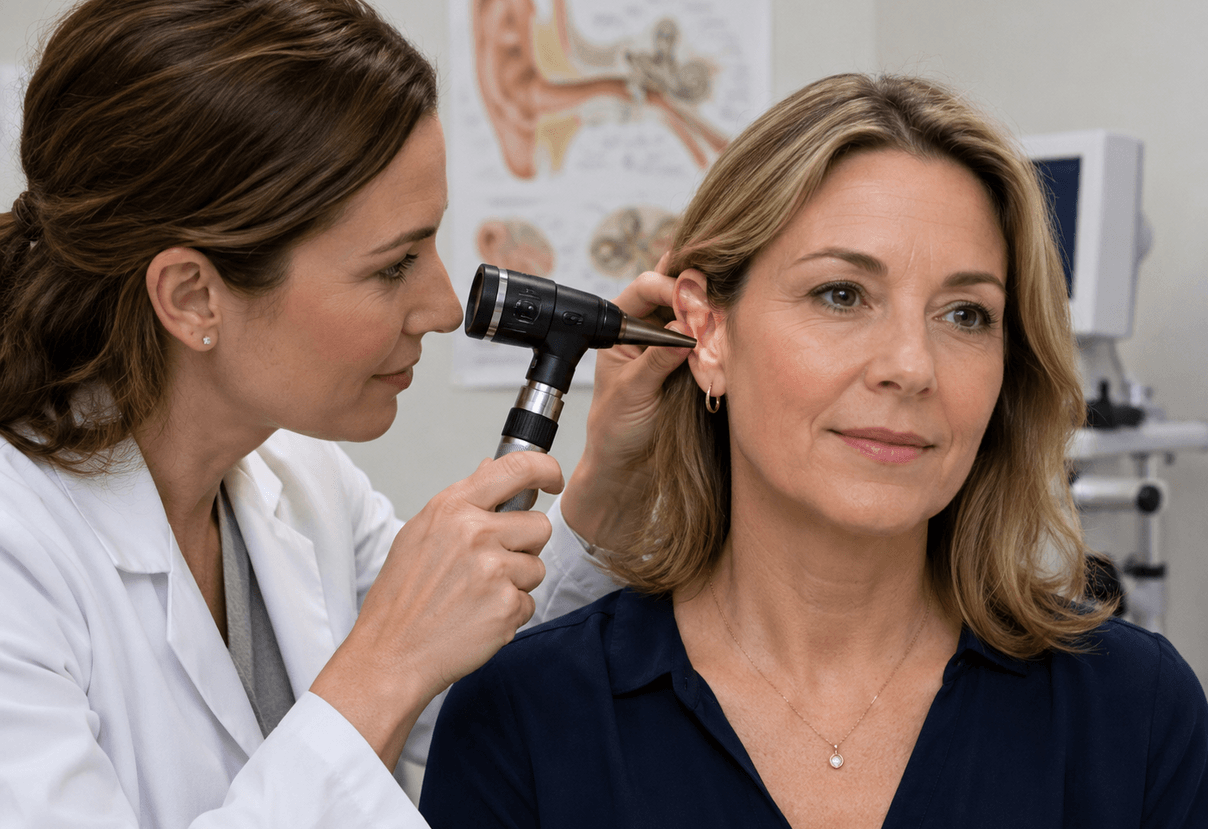
Before hearing testing begins, your audiologist will usually perform an otoscopic examination — a visual inspection of your outer ear canal and eardrum using an otoscope, a small lighted instrument. This part of the appointment is quick, painless, and typically takes about a minute per ear.
The goal is to identify anything that could affect your hearing test results or require medical attention before testing continues. Your audiologist will look for:
- Earwax (cerumen) buildup
- Signs of ear infection
- Fluid or inflammation
- Eardrum perforation
- Foreign objects
- Structural abnormalities of the ear canal or eardrum
Ear wax removal
If significant earwax is present, your audiologist may recommend removing it before testing to improve accuracy. Earwax removal methods may include:
- Manual removal using specialized tools such as a curette or small forceps
- Irrigation (flushing the ear with water), when appropriate
- Suction using a small medical vacuum device
In some cases, you may be referred to a physician if the wax is impacted, deeply positioned, or difficult to remove safely.
If you tend to build up earwax, your audiologist may recommend softening it before your appointment using a few drops of mineral oil or over-the-counter earwax-softening drops used as directed. However, do not use ear drops if you have a known or suspected eardrum perforation unless instructed by a healthcare professional.
It’s also best to avoid using cotton swabs (Q-tips) before your appointment. They often push wax deeper into the ear canal, which can make removal more difficult.
Step 3: tympanometry — testing middle ear function
Tympanometry is a quick, objective test that evaluates how well your middle ear is functioning by measuring how your eardrum responds to gentle changes in air pressure.
During the test, your audiologist places a soft probe tip into the ear canal. The device briefly changes air pressure while measuring your eardrum’s movement. You do not need to respond or do anything during the test other than sit still and relax. The test usually takes less than 30 seconds per ear.
Tympanometry is generally painless and unnoticeable, although some people may feel mild pressure changes during the test. However, if you have an active ear infection or significant ear inflammation, the test may feel temporarily uncomfortable.
The results, called a tympanogram, help your audiologist identify problems involving the middle ear. A normal result suggests the eardrum is moving properly and middle ear pressure is healthy. Abnormal results may suggest:
- Fluid behind the eardrum
- Eardrum perforation
- Problems involving the tiny middle ear bones
- Stiffness in the middle ear system
- Eustachian tube dysfunction
This information helps your audiologist determine whether hearing loss may be conductive (related to the outer or middle ear) or sensorineural (related to the inner ear or auditory nerve).
Tip from Dr. Hinson, Au.D.: Some people feel like they hear better after “popping” their ears. However, do not pop your ears before tympanometry or the hearing test unless your audiologist tells you to. This can change middle ear pressure and may affect your test results.
Step 4: hearing booth testing — pure-tone, bone conduction, and speech testing
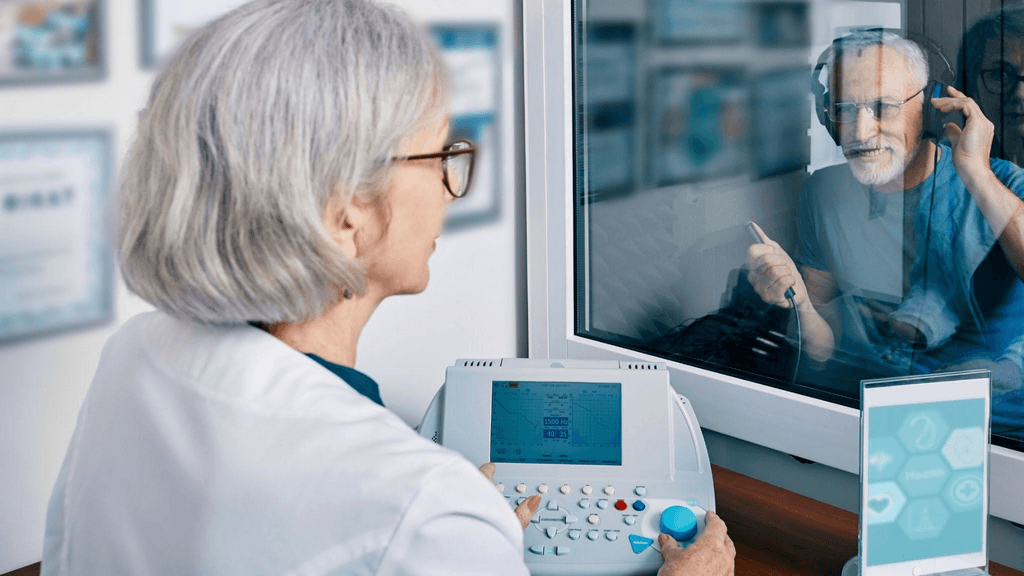
This part of the hearing evaluation takes place inside a sound-treated booth or quiet testing room. Your hearing professional will perform different tests to measure your ability to hear sounds and how clearly you understand speech in everyday situations.
Several different tests are typically performed in sequence, and your audiologist may change headphones or equipment between tests.
Pure-tone testing
Pure-tone audiometry measures the softest sounds you can hear at different pitches. This portion of testing includes both air conduction and bone conduction testing.
Air conduction testing
Air conduction testing is usually performed first. You’ll wear headphones or soft insert earphones and respond whenever you hear a beep or tone — usually by pressing a button or raising your hand.
The tones are presented at different pitches and volumes to measure your hearing thresholds across frequencies to evaluate how sound travels through the entire hearing system.
Your results are recorded on a graph called an audiogram, which shows how well you hear low-, mid-, and high-frequency sounds in each ear.
Some people become anxious if they do not hear sounds for a period of time, but that is completely normal. Your audiologist may be changing frequencies, switching ears, double-checking responses, or preparing for the next part of testing.
Bone conduction testing
Bone conduction testing is often performed after air conduction testing. During this part of the test, your audiologist places a small vibrating device behind the ear or on the forehead while you continue listening for tones.
Your audiologist may also reposition or change the headphones or insert earphones during this portion of testing. Bone conduction bypasses the outer and middle ear and sends sound directly to the inner ear.
During bone conduction testing, some people notice soft static or wind-like sounds. These sounds help the audiologist confirm which ear is responding and improve test accuracy. As with the earlier test, only respond when you hear the actual test tones or beeps.
This test bypasses the outer and middle ear and sends sound directly to the inner ear. Comparing these results with air conduction testing results helps determine if the type of hearing loss is conductive, sensorineural, or mixed.
Speech audiometry testing
Speech audiometry measures how well you hear and understand spoken words. While pure-tone testing measures your ability to detect sounds, speech testing helps your audiologist understand how clearly you process speech in everyday listening situations.
Two speech tests are commonly included:
- Speech reception threshold (SRT) testing measures the softest level at which you can correctly repeat simple two-syllable words, such as “baseball” or “hotdog.” This should closely match pure-tone results.
- Word recognition testing (WRS) measures how clearly you process speech when volume is loud enough for you to hear comfortably. During this test, you’ll repeat a list of single-syllable words presented through headphones or earphones.
Word recognition scores often reflect the real-world communication difficulties many people with hearing loss experience. Some people can hear that someone is speaking but still struggle to understand what is being said, especially in noisy environments.
Tip from Dr. Hinson, Au.D.: WRS results also help your hearing professional predict how successful hearing aids may be. In general, stronger word recognition scores are associated with easier adjustment to amplification and clearer speech understanding with hearing aids. Lower scores may indicate greater difficulty processing speech, even when sounds are loud enough to hear, which can help guide hearing aid recommendations, counseling, and communication strategies.

Step 6: reviewing your audiogram and results
Once testing is complete, your hearing professional will review and explain your audiogram and what the results mean. This is one of the most important parts of the appointment, so don’t hesitate to take your time and ask questions.
Your audiogram shows:
- Which pitches or frequencies you hear well
- Which sounds are harder for you to hear
- Whether hearing loss affects one ear or both
- The type and degree of hearing loss present
Your hearing professional will also explain how your results may affect everyday communication. For example, certain hearing loss patterns may make it difficult to hear higher-pitched speech sounds, follow conversations in background noise, or understand speech clearly even when voices sound loud enough.
They may also discuss whether your hearing loss pattern is consistent with age-related change, noise exposure, or something that warrants further investigation or medical referral.
If anything is unclear, ask questions. You should leave the appointment with a basic understanding of your hearing test results, what they mean for daily life, and whether additional treatment, monitoring, or medical follow-up is recommended.
Step 7: additional testing (when indicated)
Depending on what the initial evaluation reveals, your audiologist may recommend or perform additional testing during the same visit or at a follow-up appointment. Common additional tests include:
- Otoacoustic emissions (OAE) testing — an objective measure of outer hair cell function, frequently used with infants and young children where additional confirmation of cochlear status is needed. This is typically performed same-day.
- Auditory brainstem response (ABR) — a specialized test that measures how the auditory nerve and brain respond to sound. ABR testing is not commonly part of a routine hearing evaluation and is usually scheduled separately, sometimes with special preparation instructions involving medications, alcohol, or sleep scheduling for children.
- Acoustic reflex testing — a same-day test that measures an automatic middle ear muscle response to sound. It is commonly performed when conductive hearing loss or auditory nerve concerns are suspected and provides additional information about middle ear and auditory pathway function.
- Extended high-frequency audiometry — testing above the standard 8,000 Hz hearing range. This is not common but can often be added the same day for tinnitus evaluation, ototoxicity monitoring, or certain types of sudden hearing loss.
Step 8: reviewing recommendations and next steps
Your appointment usually ends with a discussion of your results and what, if anything, should happen next. Your audiologist should explain the reason for each recommendation and give you time to ask questions.
Depending on your results, next steps might include:
- No treatment needed right now, with a recommendation for a future hearing evaluation
- Referral to an ENT or other medical specialist
- A hearing aid evaluation to discuss device options, technology levels, lifestyle needs, and budget
- Tinnitus management
- Vestibular assessment if balance concerns are present
- Auditory rehabilitation or communication strategy counseling
You should leave understanding why a recommendation was made, what to expect next, and what may happen if you choose to wait or explore other options. A good hearing professional will explain your choices clearly and without pressure.
How long does an audiology appointment take?
A comprehensive initial audiology evaluation typically takes 30 to 60 minutes, depending on whether paper work and medical history were completed and reviewed ahead of time. Appointment time covers the case history discussion, ear examination, hearing testing, results review, and recommendations.
If additional testing is needed, the appointment may take longer or certain tests may be scheduled for a follow-up visit.
Future appointments — such as hearing aid fittings, cochlear implant programming, tinnitus management, or vestibular testing — are usually scheduled separately and may have different time requirements.
Why a comprehensive hearing evaluation matters
An audiology appointment is designed to give you a clear understanding of your hearing health and any communication challenges you may be experiencing. From the case history and ear examination to hearing and speech testing, each part of the evaluation helps your hearing professional identify not just whether hearing loss is present, but how it may be affecting your everyday life.
Knowing what to expect can make the experience feel less intimidating and help you participate more confidently in the process. Whether your results show normal hearing, hearing loss, tinnitus concerns, or the need for additional testing, a comprehensive hearing evaluation is an important step toward protecting your long-term hearing and communication health.
When should you see an audiologist?
Who will be doing my hearing test?
Tips from audiologist Dr. Hinson for getting the most from your appointment
Step 1: the case history interview
Step 2: otoscopy
Step 3: tympanometry
Step 4: hearing booth testing
Step 6: reviewing your audiogram and results
Step 7: additional testing
Step 8: reviewing recommendations and next steps
How long does an audiology appointment take?
Why a comprehensive hearing evaluation matters


Frequently asked questions
Is a hearing test painful or uncomfortable?
No. The standard components of an audiology evaluation — otoscopy, tympanometry, pure-tone audiometry, speech audiometry — are all entirely non-invasive and painless. Tympanometry involves a brief sensation of pressure in the ear canal, similar to what you feel when a car window goes down quickly, but it causes no discomfort. If cerumen removal is needed, that process can occasionally be momentarily uncomfortable, but a skilled audiologist minimizes discomfort and will stop if anything is causing pain.
What should I do if I'm nervous about my results?
It is completely normal to feel anxious before a hearing evaluation, particularly if you have been aware of changes in your hearing for some time. A few things are worth keeping in mind: whatever the audiogram shows, it is information — and information, even when it reveals a problem, is what makes treatment and management possible. Knowing the nature and degree of your hearing loss precisely is the first step to addressing it effectively. If you are anxious, tell your audiologist. A good clinician will take the time to explain findings clearly and supportively rather than simply presenting numbers.
How often should I have a hearing evaluation?
For adults with no prior hearing concerns and no significant risk factors, a baseline evaluation in the early 50s provides a reference point for future monitoring. After that, evaluations every three to five years are generally appropriate for adults who have not had significant changes in hearing status — though your audiologist will recommend a schedule based on your specific results and risk profile. Anyone with noise exposure history, a family history of hearing loss, tinnitus, or any symptoms of hearing difficulty should be evaluated and then monitored at intervals your audiologist recommends. Existing hearing aid users are typically seen at least annually.
Will my insurance cover an audiology evaluation?
Coverage varies significantly by plan. Many commercial health insurance plans cover diagnostic audiology evaluations when they are medically necessary — particularly when ordered by a physician — but may not cover routine hearing screenings or hearing aid fittings. Medicare covers diagnostic hearing tests in specific circumstances but does not currently cover hearing aids as a standard benefit. Verify your coverage before your appointment by contacting your insurance provider directly, and ask the audiology practice’s billing staff to confirm what they expect your plan to cover based on your referral reason and the specific billing codes involved.
What is a word recognition score, and why does it matter?
Your word recognition score — expressed as a percentage — reflects how accurately you understand speech when it is loud enough to hear comfortably. A score of 100 percent means you correctly repeated every word on the test list. Scores typically decline with increasing degree of sensorineural hearing loss, and the score often does not improve proportionally with amplification when it falls significantly below normal ranges. Your word recognition score helps your audiologist predict how you will benefit from hearing aids, understand why you may struggle in conversation even when sounds seem loud enough, and determine whether your pattern of loss is consistent with cochlear damage or suggests involvement of the auditory nerve.