
Degrees of Hearing Loss: Explaining Mild to Profound Cases


Hearing loss is commonly described in degrees, ranging from mild to profound. These categories are based on how loud a sound needs to be before it can be heard during a hearing test and are one of the primary ways audiologists describe hearing ability. Degrees of hearing loss help standardize test results, guide treatment decisions, and provide a shared language for understanding changes in hearing over time.
It’s also important to know that degrees don’t capture everything about how someone hears in daily life. Different types of hearing loss can affect each ear differently, impact certain pitches more than others, and influence how clearly speech is understood, especially in background noise. Because degrees measure loudness rather than clarity, two people with the same degree of hearing loss may have very different listening experiences.
In this article, we’ll explain how degrees of hearing loss are measured, what mild through profound hearing loss typically means, how to read an audiogram, and why factors like speech understanding and pitch matter alongside the degree itself.
How hearing is measured
Audiologists use different types of hearing tests, most commonly a pure-tone test, to measure hearing ability across different frequencies. During the test, you listen to sounds through headphones and respond when you hear them. The results are recorded on an audiogram, which visually shows hearing sensitivity across a range of pitches.
Two main things are measured, with each ear tested separately:
- Pitch (frequency): How high or low a sound is, measured in Hertz (Hz).
- Volume (loudness): How loud a sound needs to be before you can hear it, measured in decibels (dB HL).
Audiograms help identify the degree and pattern of hearing loss and play an important role in guiding treatment recommendations.
Defining degrees of hearing loss
Degrees of hearing loss describe how loud a sound must be before it can be heard during a hearing test and are often the first step in identifying and describing hearing changes. Audiologists use these categories to summarize hearing sensitivity, compare results across ears, and guide decisions about monitoring or treatment. They provide a clear, standardized way to understand hearing test results and talk about changes over time.
Degrees of hearing loss at a glance
| Degree of hearing loss | dB range | What may be harder to hear |
|---|---|---|
| Mild | 26–40 dB | Soft speech, whispers, conversations in noise |
| Moderate | 41–55 dB | Normal conversation, group speech |
| Moderately severe | 56–70 dB | Loud speech without amplification |
| Severe | 71–90 dB | Most speech without hearing devices |
| Profound | 91+ dB | Most sounds, including speech |
In practice, degree is just one part of the overall picture. Audiologists may also consider how well speech is understood, how hearing performs in background noise, and which pitches are affected when making recommendations. Together, these measures help guide accurate diagnosis and personalized care.
Mild Hearing Loss (26–40 dB)
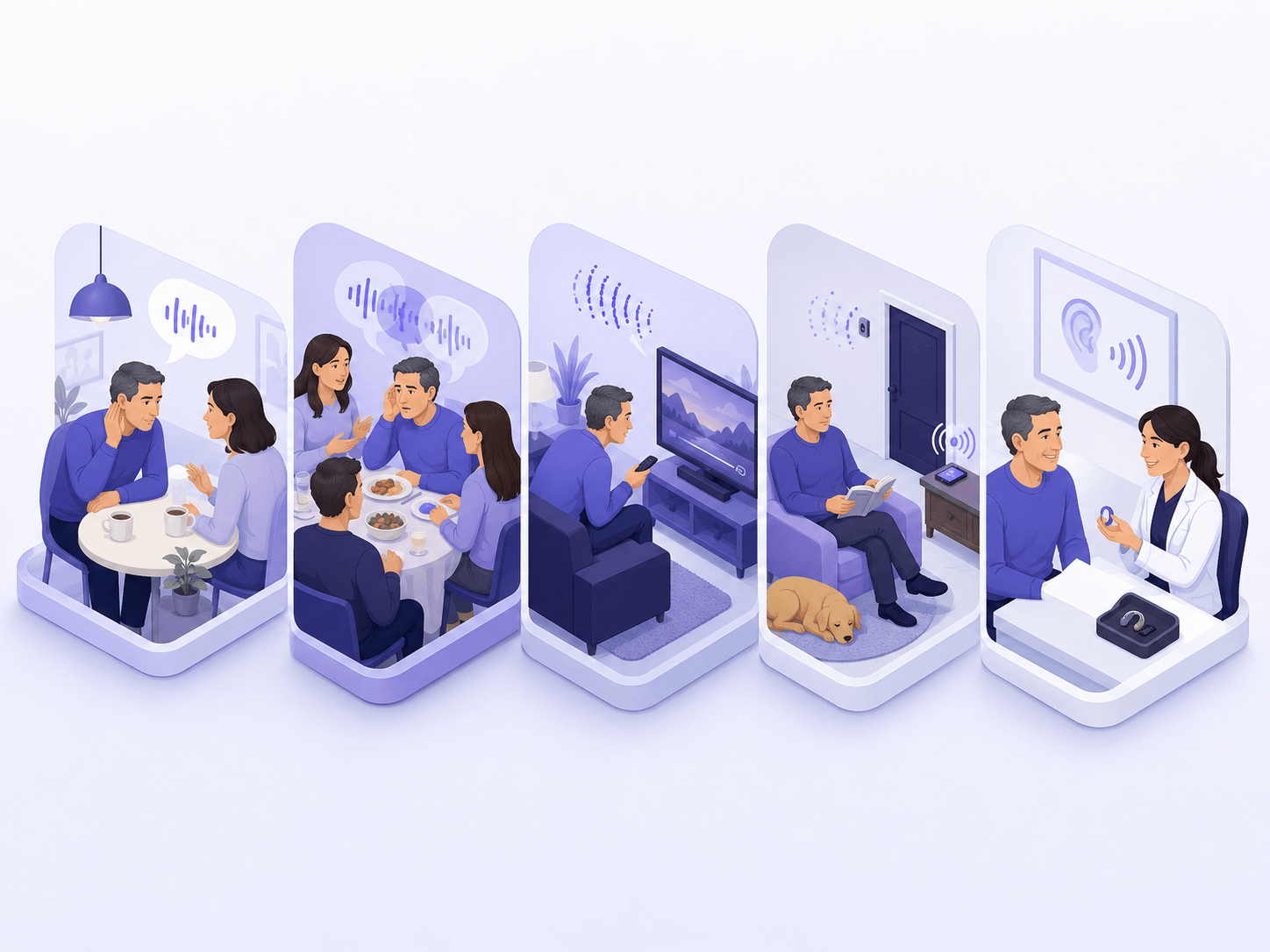
Mild hearing loss can be easy to overlook. You may hear well in quiet settings but struggle in noisy environments, with soft-spoken voices, or when someone speaks from another room. Because hearing still feels “mostly normal,” many people delay getting checked. Over time, even mild hearing loss can increase listening effort and lead to fatigue or frustration.
Moderate Hearing Loss (41–55 dB)
With moderate hearing loss, following everyday conversations becomes more challenging, especially in groups or noisy settings. People may turn up the TV, miss parts of conversations, ask others to repeat themselves more often, or rely on facial cues for clarity. At this stage, hearing support like over-the-counter hearing aids is commonly recommended to reduce listening effort and improve communication.
Moderately Severe to Severe Hearing Loss (56–90 dB)
At these levels, speech is much harder to understand without amplification. Even loud voices may sound unclear or distorted, and conversations often rely heavily on visual cues. Communication can feel challenging in both social and everyday situations. More powerful hearing aids typically play an important role in supporting communication and quality of life.
Profound Hearing Loss (91+ dB)
With profound hearing loss, most sounds, including speech, are not heard without specialized support. Communication may rely on advanced devices, visual cues, or alternative strategies. With guidance from a licensed audiologist, many people with profound hearing loss find effective ways to communicate and stay engaged in daily life.
Why early identification matters
Identifying hearing loss early can make a meaningful difference. Early care can help reduce listening fatigue, support clearer communication, and make it easier to adapt to changes over time. Even small changes in hearing are worth checking, especially if conversations are starting to feel more tiring or frustrating.
A licensed audiologist can provide a comprehensive evaluation and help you explore hearing solutions tailored to your needs and lifestyle.
Understanding the limits of hearing loss degrees
Degrees of hearing loss describe how loud sounds need to be before they’re heard, but they don’t fully explain how hearing works in everyday life. Two people with the same degree of hearing loss can have very different experiences, depending on which sounds are affected and how the brain processes speech.
Common reasons hearing may feel harder than expected include:
- Difficulty separating speech from background noise. Hearing loss often affects how the brain filters speech from competing sounds, which is why restaurants or group settings can feel especially challenging. Audiologists assess this using speech-in-noise testing, which helps explain real-world listening struggles. When background noise is the main challenge, many find relief using noise-cancelling hearing aids.
- Missing important speech details. High-pitched sounds, especially consonants that add clarity to words, are often affected first. Even when voices sound loud enough, missing these details can make speech feel muffled or unclear.Pure-tone testing helps identify which pitches are affected, while speech testing helps audiologists understand how those changes impact clarity.
- Differences between ears. When hearing varies from one ear to the other, the brain has to work harder to understand speech and locate sound. Audiologists may look closely at asymmetrical hearing loss during testing to guide treatment decisions.
Choosing the right support for your hearing level
There’s no one-size-fits-all solution for hearing loss. Knowing your degree of hearing loss is an important starting point, but how hearing loss affects daily life also depends on factors like speech clarity, background noise, and differences between ears. This is why hearing care is always individualized.
In general, moderate hearing loss and above is where hearing support becomes most critical. At these levels, everyday conversations often become difficult without amplification, and untreated hearing loss can significantly affect communication and quality of life.
The right approach depends on your hearing test results, how you communicate day to day, and what listening situations matter most to you. A licensed audiologist can help explain your results, discuss your goals, and recommend solutions that fit your hearing needs and lifestyle.
Frequently Asked Questions
How often should I have my hearing tested?
Most adults benefit from a hearing test every 3 to 5 years, even if they don’t notice changes. As hearing naturally shifts with age, many audiologists recommend testing every 1 to 3 years after age 40 and annually after age 60. People with noise exposure, hearing symptoms, or other risk factors may need more frequent evaluations based on individual circumstances.
Can the degree of hearing loss change over time?
Yes. Hearing loss can change due to aging, noise exposure, certain medical conditions, or medications. Regular hearing evaluations help track changes over time and allow adjustments to care or technology as needed.
Are hearing aids effective for severe or profound hearing loss?
Hearing aids can be very effective for many people with severe hearing loss, especially when professionally fitted and programmed. In some cases, additional assistive devices or other treatment options may be recommended to support communication.
Can hearing loss be different in each ear?
Yes. It’s common for hearing loss to vary between ears. Testing each ear separately helps audiologists understand how your ears work together and tailor recommendations accordingly.
Should I see an audiologist for mild hearing loss?
Yes. Even mild hearing loss can increase listening effort and make conversations more tiring over time. Early evaluation can help you understand what’s changing and explore strategies to support communication.