
Audiology and Public Health: Why Hearing Care Matters
Understanding the population-level impact of hearing loss

What is public health audiology?
Why hearing loss is a public health issue
Newborn hearing screening: a public health success story
Noise-induced hearing loss: prevention and risk
Hearing loss and cognitive decline in older adults
Hearing loss and mental health
Barriers to hearing healthcare access
Ototoxicity and medication-related hearing loss
Public awareness and hearing health literacy
Why hearing health matters
Audiology also plays a major role in public health, shaping how hearing care is delivered across entire communities.
Reports show that over 1.5 billion people worldwide, and about 37.5 million adults in the U.S., live with some degree of hearing loss, making it one of the most common chronic conditions today.
It can affect how we communicate, work, learn, and connect with others. Our hearing health is also increasingly linked to mental and cognitive health, especially in older adults.
Audiologists help to improve public health by contributing to screening programs, prevention campaigns, occupational health frameworks, early childhood intervention systems, and the research base that shapes hearing health policy.
The 3 key takeaways
- Hearing loss is a major public health issue — Affecting over 1.5 billion people globally, it impacts communication, mental health, and cognitive function — not just individual patients, but entire populations.
- Prevention and early detection make a measurable difference — Programs like newborn hearing screening and workplace hearing conservation significantly improve long-term outcomes and reduce preventable hearing damage.
- Access to care remains a critical gap — Cost, awareness, and systemic disparities continue to limit treatment, making public health efforts and policy changes essential to improving hearing healthcare equity.
What is public health audiology?
Public health audiology focuses on preventing hearing loss, improving early detection, and expanding access to care across populations — not just treating individuals. It includes screening programs, education, policy, and community-based care designed to improve hearing health at scale.
Key aspects of public health audiology
- Prevention: Reducing noise exposure and promoting safe listening habits
- Early detection: Programs like newborn hearing screening identify hearing loss early
- Access to care: Expanding services through teleaudiology and community-based programs
- Screening and diagnostics: Population-level hearing testing and monitoring
- Education and awareness: Helping people recognize hearing loss and seek care
Together, these efforts define how audiology operates at a population level. In practice, audiologists contribute to each of these areas through clinical care, program design, and patient education.
Why hearing loss is a public health issue
Hearing loss is one of the most common chronic health conditions worldwide — and one that is often untreated.
The average person waits several years after first noticing hearing difficulty before seeking care, and many never receive treatment at all. The ramifications of untreated hearing loss — including social isolation, depression, reduced economic productivity, and accelerated cognitive decline — extend far beyond the individual.
For example, the 2020 Lancet Commission on dementia prevention, intervention and care identified hearing loss as among the most significant potentially modifiable risk factors for dementia across the lifespan. This means that addressing hearing loss could play a meaningful role in reducing dementia risk at a population level.
Continued research about hearing health makes it clear that this is a serious public health issue with important implications for aging populations and long-term health outcomes.
Audiologists help address these challenges by identifying hearing loss early and guiding patients toward appropriate treatment and support.
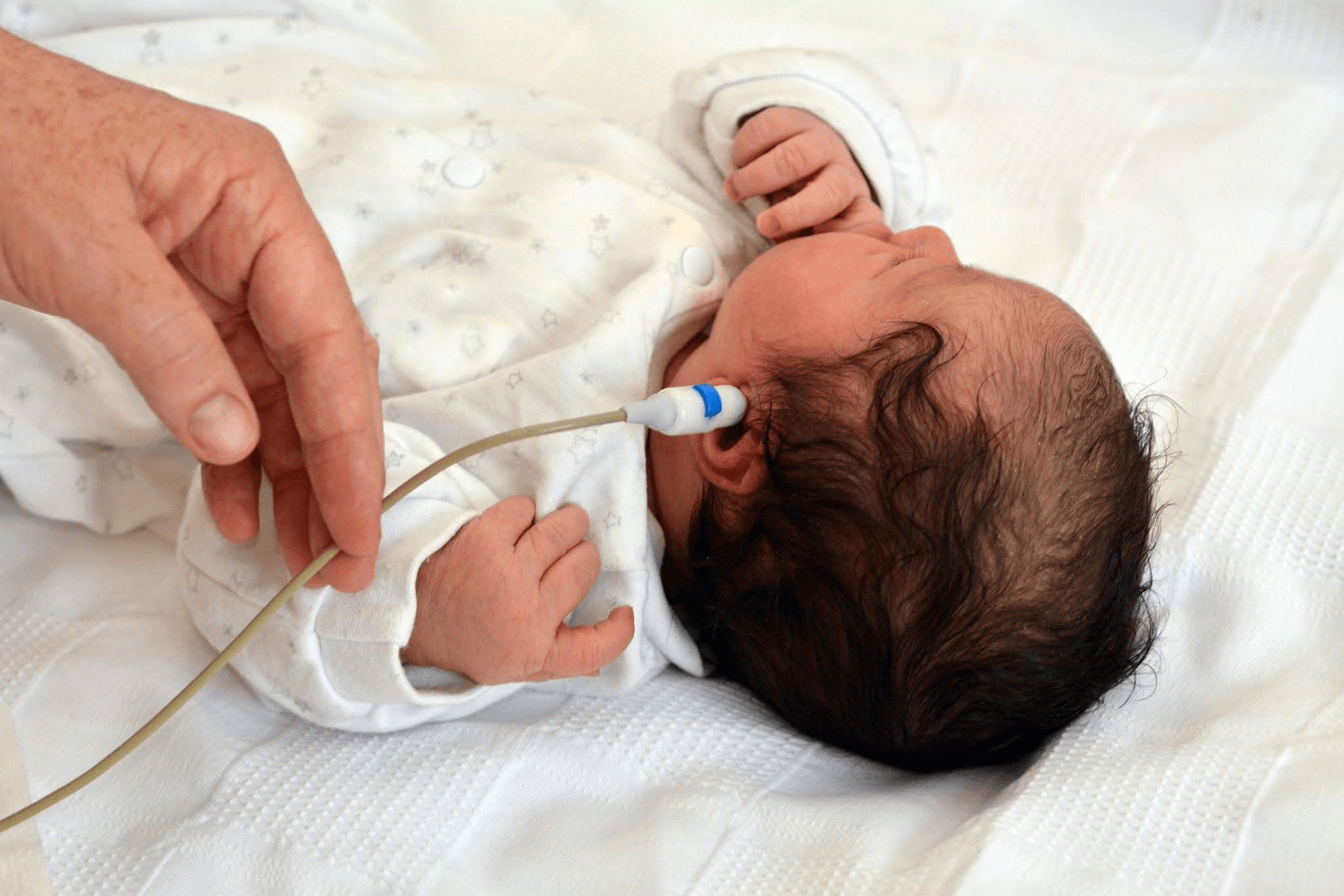
Newborn hearing screening: a public health success story
Universal newborn hearing screening is one of audiology’s biggest public health successes — and one of the clearest examples of how a well-designed screening program can change outcomes at scale. Before this program existed, hearing loss in children was often identified at age 2 or 3 — after critical language development had already begun.
Today, all 50 U.S. states now require hearing screening before hospital discharge, and CDC data show that more than 98% of newborns are screened each year. When hearing loss is identified early and treated quickly, the developmental outcomes for children are markedly better than in the pre-screening era. Children identified at birth and enrolled in early intervention before 6 months of age consistently demonstrate stronger language outcomes than those identified later.
However, infants who do not pass the initial screening but do not complete the recommended diagnostic evaluation remain higher than the field considers acceptable, particularly in underserved communities. Audiology’s public health contribution includes the work of closing those follow-up gaps.
Noise-induced hearing loss: prevention and risk
Noise-induced hearing loss is preventable — yet it remains one of the most common causes of permanent hearing damage in the United States.
The National Institute for Occupational Safety and Health (NIOSH) estimates that approximately 22 million U.S. workers are exposed to hazardous occupational noise levels each year. This type of hearing loss also carries a financial cost, with hundreds of millions of dollars spent annually on workers’ compensation.
Audiologists play a key role in preventing noise-related hearing damage.
In workplaces, they help design hearing conservation programs for industries with high noise levels. These programs may include regular hearing tests, monitoring noise exposure, recommending protective equipment, and educating workers about risks.
OSHA requires these programs when noise levels reach 85 decibels or higher over an eight-hour workday. This standard applies across industries like construction, manufacturing, aviation, agriculture, and the military.
Outside the workplace, audiologists also educate the public about safe listening habits — especially when using headphones or attending loud events.
Simple steps, like lowering volume and using ear protection, can significantly reduce your risk of permanent hearing loss.
The WHO estimates that more than a billion young people worldwide are at risk due to unsafe listening practices.
Hearing loss and cognitive decline in older adults
The relationship between untreated hearing loss and accelerated cognitive decline has become one of the most important and actively researched topics in hearing health. Longitudinal research — including landmark work from Johns Hopkins and subsequent large-scale investigations — has documented consistent associations between hearing loss and increased risk of dementia, cognitive decline, and social isolation in older adults.
As the population ages, this connection becomes more important. Even small improvements in hearing care could have a meaningful impact on long-term brain health.
While researchers are careful not to claim that treating hearing loss prevents dementia, the ACHIEVE trial — the most rigorous study to date examining the connection between hearing intervention and brain health in older adults — suggests it may play a meaningful role in slowing cognitive decline in certain populations.
Audiologists help translate this research into care by identifying hearing loss and recommending interventions that may support long-term brain health.
“In clinical practice, we’re careful to talk about associations rather than guarantees around hearing loss treatment preventing dementia. However, the ACHIEVE trial shows that of those with other comorbidities, such as cardiac dysfunction, hearing intervention slowed cognitive decline by nearly 50%. That is nothing to scoff at.”
— Dr. Jessica Hinson, Au.D.
Hearing loss and mental health
The mental health consequences of untreated hearing loss are well-documented and clinically significant. Research consistently finds elevated rates of depression, anxiety, and social isolation among people with hearing loss who are not receiving adequate treatment.
The reasons are often cumulative. Conversations require sustained, effortful listening. Social environments become harder to navigate. Repeated misunderstandings can lead to frustration and withdrawal. Over time, many people begin to disengage from social interactions altogether. This can lead to loneliness, anxiety, and depression.
Published research has found that adults with untreated hearing loss report significantly lower quality of life, higher rates of depressive symptoms, and greater social isolation compared to both hearing peers and individuals with hearing loss who use amplification.
From a public health perspective, treating hearing loss supports both communication and emotional well-being.
Barriers to hearing healthcare access
One of the biggest challenges in hearing healthcare is access. Audiological evaluation, hearing aids, and cochlear implants are not equitably distributed, and the gaps follow familiar patterns of socioeconomic disadvantage and structural inequality.
Key barriers to access include:
- The cost of hearing aids — Prescription hearing aids often cost several thousand dollars per pair. While OTC hearing devices have improved affordability and access, they are only recommended for adults with mild to moderate hearing loss.
- Limited insurance coverage — Government programs and insurance coverage for hearing care typically offers little to no help, leaving many patients with significant out-of-pocket expenses.
- Disparities in use — Only a minority of people who could benefit from hearing aids use them. Adoption rates are lowest among lower-income adults and older adults on fixed incomes. Racial and ethnic disparities are also significant — one large study found hearing aid use rates of about 9–10% among Black and Hispanic older adults, compared to nearly 32% among White older adults.
These disparities cannot be solved by clinical practice alone, but audiologists who are aware of them are better positioned to adopt approaches that reduce rather than inadvertently perpetuate them.
Ototoxicity and medication-related hearing loss
Some medications — like certain chemotherapy drugs, aminoglycoside antibiotics, and high doses of loop diuretics — used to treat serious health conditions can damage hearing as a side effect. This drug-induced hearing loss is called ototoxicity.
One of audiology’s clearest preventive roles is monitoring hearing during medication use and working with care teams to protect patients’ hearing — helping detect changes early before more damage occurs.
Ototoxicity monitoring usually includes a baseline hearing test before treatment begins, followed by regular follow-up testing during treatment. If early changes show up, that information can help the care team decide whether changes to the treatment plan are possible.
Public awareness and hearing health literacy
Many people still do not realize how common hearing loss is — or how much it can affect daily life.
Some people dismiss the early signs of hearing loss. Others may not realize their communication struggles are related to hearing. Many also do not know when to seek help or what treatment options are available.
That is why public education matters. Audiology supports public health not only through testing and treatment, but also through awareness campaigns, patient education, and outreach.
The goal is not just to fill appointment books; it is to ensure that people with hearing loss understand what is happening, what it means for their broader health, and what they can do about it. That kind of informed engagement is both a clinical and a public health outcome worth investing in.
Why hearing health matters
Audiology’s impact on public health spans prevention, early identification, treatment access, occupational safety, cognitive health, and the reduction of mental health burdens associated with untreated hearing loss.
Audiologists help patients one at a time, while also contributing to broader public health efforts that improve outcomes across communities.
For patients, that bigger picture matters. Taking care of your hearing is not just about improving sound today — it’s also an important part of protecting your long-term health and quality of life in the years ahead.
What is public health audiology?
Why hearing loss is a public health issue
Newborn hearing screening: a public health success story
Noise-induced hearing loss: prevention and risk
Hearing loss and cognitive decline in older adults
Hearing loss and mental health
Barriers to hearing healthcare access
Ototoxicity and medication-related hearing loss
Public awareness and hearing health literacy
Why hearing health matters


Frequently asked questions
Is hearing loss considered a disability under U.S. law?
Yes. The Americans with Disabilities Act (ADA) recognizes hearing loss as a disability and requires covered employers, public accommodations, and government entities to provide reasonable accommodations and effective communication access for people with hearing loss. The ADA does not define disability by a specific audiometric threshold — it focuses on functional limitation and its impact on major life activities. People with hearing loss who face discrimination in employment or access to public services have recourse under the ADA and related federal statutes.
How does untreated hearing loss affect quality of life?
Research consistently finds that untreated hearing loss is associated with significantly reduced quality of life including elevated rates of depression and anxiety, greater social isolation and loneliness, reduced workplace productivity, and, in older adults, accelerated cognitive decline. The good news is that many of these effects can improve with proper treatment and support.
What is being done to improve access to hearing healthcare?
Several policy and clinical developments are actively expanding access. The FDA’s 2022 OTC hearing aid ruling has reduced cost and access barriers for some adults with mild to moderate hearing loss. Advocacy by ASHA, the AAA, and the Hearing Loss Association of America has helped keep hearing care access on the legislative agenda — including efforts like the Medicare Audiology Access Improvement Act, which aims to expand Medicare coverage and reduce barriers to care.Teleaudiology is expanding geographic reach in underserved communities. And efforts to integrate hearing screening into primary care are gaining traction in some health systems. Progress is real but uneven, and significant access gaps persist — particularly for low-income and rural populations.
Can hearing loss be prevented?
A meaningful proportion of hearing loss is preventable. Noise-induced hearing loss — the most common preventable cause — can be substantially reduced through hearing protection in high-noise environments, safe listening habits with personal audio devices, and effective workplace hearing conservation programs. Some forms of infection-related hearing loss can be prevented through vaccination. Ototoxic medication monitoring can reduce drug-induced damage. Age-related hearing loss cannot currently be prevented, but consistent noise protection across the lifespan and management of cardiovascular risk factors may reduce the rate of age-related decline in some individuals.
Why don't more people with hearing loss seek treatment?
The barriers are multiple and well-documented: cost (hearing aids are expensive and inconsistently covered by insurance), stigma (particularly among men and younger adults who associate hearing aids with age or infirmity), lack of awareness (many people do not identify their communication difficulties as a hearing health condition), and access challenges (shortage of audiologists in rural areas, difficulty navigating the clinical system). Reducing these barriers through policy, technology, and public awareness is one of audiology’s most important ongoing public health challenges.
What does an audiologist do in public health?
Audiologists in public health focus on prevention, screening, education, and improving access to care, rather than only treating individual patients.